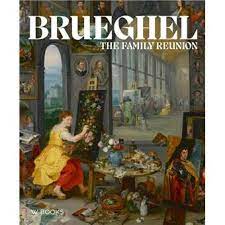
An art museum in ‘s Hertogenbosch, Netherlands, the Het Noordbrabants Museum, is throwing a “family reunion” for the Bruegels / Brueghels. The exhibition, Brueghel: The Family Reunion, covers nearly 200 years of painting from this famous family. The exhibition covers five generations of the Bruegel family, including his sons, grandchildren and mother-in-law. All were influential painters, creating a dynasty throughout the sixteenth and seventeenth century. The family was responsible for the “Bruegel craze” that occurred around 1600, after the most famous member of the family, Pieter Brueghel the Elder, had died. The exhibit is captured in a compelling monograph with wonderful essays published by WBOOKS (www.wbooks.com).
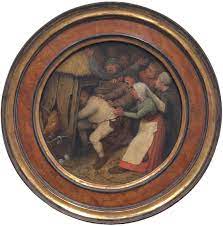
The head of the dynasty, Pieter Bruegel the Elder, is represented in the exhibition by several paintings which seldom leave their home museum. Or, in the case of “The Drunkard Pushed into the Pigsty,” from 1557, are on a rare loan from a private collection.
The role of the women in the Bruegel family is a focus of the monograph. After Pieter Bruegel the Elder died, Pieter the Younger and Jan the Elder, who were very young children, were taught to paint by Bruegel’s mother in law, Mayken Verhulst. Mayken was an artist in her own right, who took over the daily business operations of the workshop of her husband, Pieter Coecke Van Aelst’s, after he died. She not only transferred her artistic knowledge, with documentary evidence showing that she instructed Jan Brueghel the Elder in watercolor painting, but also business knowledge related to how to run a large-scale workshop, which both Pieter the younger and Jan the Elder, did later in life.
The Brueghel family’s interest in the outside world, including elemental and seasonal cycles , depicting plants, animals and weather patterns, can be found in select paintings of the family members. Jan Brueghel the Elder specialized early on in landscapes and the elements. The monograph depicts a series of one of the earliest series, which was so popular it was copied with variations into the 17th century, by not only Jan, but by his son Jan Brueghel the Younger. David Teniers the Younger, the son-in-law of Jan Brueghel the Elder, turned his attention to weather phenomena, and used masterful brushstrokes to evoke emotion.
Paintings of collectors’ cabinets began with Jan Brueghel the Elder and continued for generations, including a fine example by Jan van Kessel included in the monograph. Nearly one-quarter of his surviving oeuvre are depictions of insects. Many works have van Kessel painting the letters of his name in the form of caterpillars and snakes, tying art and nature together. Painters such as Jan Brueghel and Jan van Kessel studied nature and objects with an eye for detail, creating depictions so accurate that they could “seduce and deceive the eye of the viewer.”
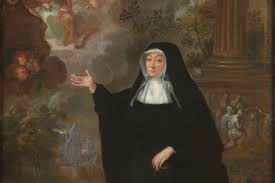
The final chapter of the monograph focuses on women and artistic knowledge in the family, with a focus on Clara Eugenia, eighth child of Jan Brueghel I and Catharina van Marienbergh. Clara Eugenia chose to live her life in a semi-monastic residential community for women. Called Beguines, these communities offered women a supportive alternative to marriage and motherhood. Clara Eugenia took the post of church mistress and served as godmother not only for her brother Jan II’s daughter, but also for Clara Teniers, daughter of her sister Anna and David Teniers II. A wonderful portrait of Clara Eugenia is presented in the exhibit and monograph.
The bright, bright vibrant reproductions of the paintings in the monograph make this an essential work for those interested in the Bruegel family. While viewing the works in person should be a priority for those in the region, for others who are not able to attend (or for those that want a wonderful memento), this monograph is a wonderful substitute.
 BruegelNow
Discussion
No comments yet.