BruegelNow
Bruegel
Exhibition: Bosch & Bruegel Four Paintings Magnified
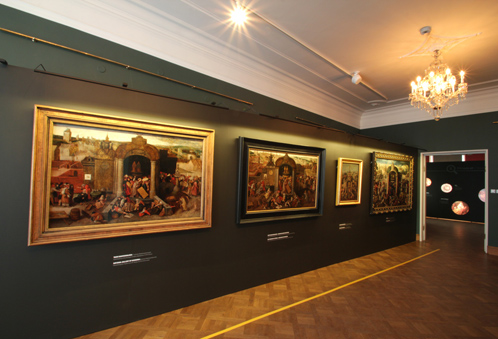
Bosch Bruegel Exhibit
Years ago, while visiting the National Gallery of Denmark, I was stopped in my tracks as I came across a painting identified as a Bruegel the Elder work. I wasn’t floored so much for the painting’s beauty, but my mouth hung open because I had never seen it or heard of it before. The painting, “Christ Driving the Money-Lenders From the Temple,” was listed in none of my many Bruegel monographs. How could this be? I wondered. How can a museum hang a work and call it “Bruegel” when everyone else in the world doesn’t agree that it is a Bruegel?
Currently a fascinating exhibit covering the painting is underway. Tracing Bosch and Bruegel: Four Paintings Magnified investigates four similar paintings that are done in the Bosch style, which was also emulated by Bruegel in his earlier paintings. The exhibit seeks to answer the questions of who painted the works and when were they painted. Further, how did these four very different paintings of essentially the same scene come to hang in the three galleries and one private collection?
While my specific question regarding the labeling of the Copenhagen painting isn’t answered in the exhibit, it does provide countless other fascinating details. You can learn more about the exhibit at the excellent website: http://www.bosch-bruegel.com. The creators of the website should be applauded at their exceptional work. While I am not likely to see the exhibit in any of the locations to which it travels, I feel as if I have experienced it due to the wealth of information provided on the web. In addition, at least two conferences and a monograph are planned around the exhibitions, with further interesting information certainly to be revealed.
I’ve really enjoyed reading the Twitter feed as the exhibit came together. Hannah Tempest did an excellent job tweeting the process of cleaning and restoration, and providing highly interesting images.
The questions remains – after the exhibit and the Copenhagen painting travels back to the National Gallery – will it still be labeled as “Bruegel?”
I’m interested to hear from folks who have seen the exhibit first hand. What was it like?
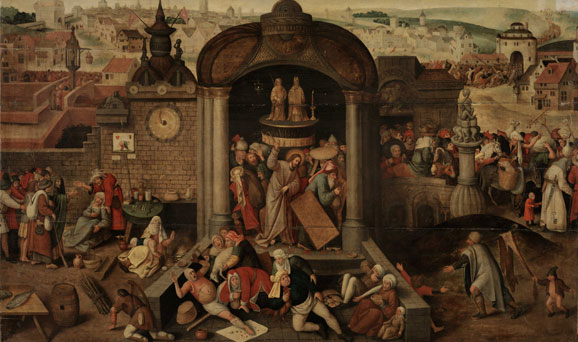
Christ Driving the Money-Lenders From the Temple
Is “The Mill and the Cross” Historically Accurate?
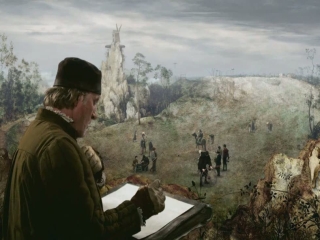
"The Mill and the Cross"
At last I was able to travel to a theater showing Lech Majewski’s “The Mill and the Cross.” Bringing to vivid life the 1564 painting “Procession On The Way to Calvary,” from the Kunsthistorische Muesum in Vienna, the film ostensibly allows us into the mind of Bruegel as he prepares to paint the work.
There are many fine reviews of the film that you can find on the web. (I’ve including a few links at the end of this post.) Because of this, I’ll focus my review on the historical accuracy of the film based on what we know of Bruegel and his patron, Nicolaas Jongelinck.
However, first let me say that I greatly enjoyed the film. (How can someone with a blog about Bruegel not find something to like in what is likely the first portrayal of Bruegel on the silver screen?) While it is impossible to know Bruegel’s thoughts while he was composing this painting, “The Mill and the Cross” offers one possible scenario. I found the film less compelling when it focused on Mary and Jesus. The story of the crucifixion has been told countless times on the screen, and I found little that was fresh in this retelling.
– The costumes were very well done and closely mirrored those in the painting, as well as clothes that can be found in other Bruegel paintings.
– While I enjoyed Rutger Hauer’s performance, he is too old to portray Bruegel in 1569, when Bruegel was approximately 35 years old. During the scenes of Bruegel and his wife Mayken Coecke van Aelst, I was pulled out of the film due to the jarring differences of their age and the fact that this does not match the historical record.
– Nicolaas Jongelinck, portrayed by Michael York, was shown in his house in a bustling city (presumably Antwerp) in the film. We know that Jongelinck’s residence in Antwerp was not in the city. Nicolaas’ house, called “‘t Goet ter Beke,” was located just outside the gates of Antwerp It was built by his brother Thomas, and was trasfered to Nicolaas on 22nd November 1554 (1). (It is possible that Jongelinck had another residence in the city, but there is no record of this.)
– The filmmaker did correctly portray Jongelinck owning a “Tower of Babel” painting by Bruegel, which can be seen in the background of several scenes set in Jongelinck’s house. We don’t know if it was the exact painting shown in the film, since Bruegel painted at least two versions of the “Tower of Babel.” The painting shown in the film is housed in the Kunsthistorische Muesum.
– Bruegel had 6 children, 5 boys and 1 girl, in the film. This could be possible if Bruegel had 4 children that did not live into adulthood, since we know that Pieter II and Jan survived him. However, there is no documented evidence regarding the number of Bruegel’s children that did not survive.
While there were some lapses of historical accuracy, the film is an entirely enjoyable exploration of the painting and of Bruegel’s time as we understand it today. We hope that it serves to introduce Bruegel to a new audience of viewers, who will then seek to learn more about the man and his painting.
(1) “The Labours of Hercules, a Lost Series of Paintings by Frans Floris,” The Burlington Magazine, Vol. 107, 1965, PP 114 – 123.
Further reading / reviews of “The Mill and the Cross”
http://www.imdb.com/title/tt1324055/
http://www.hollywoodreporter.com/review/mill-cross-berlin-review-97627
Landscape With The Fall of Icarus
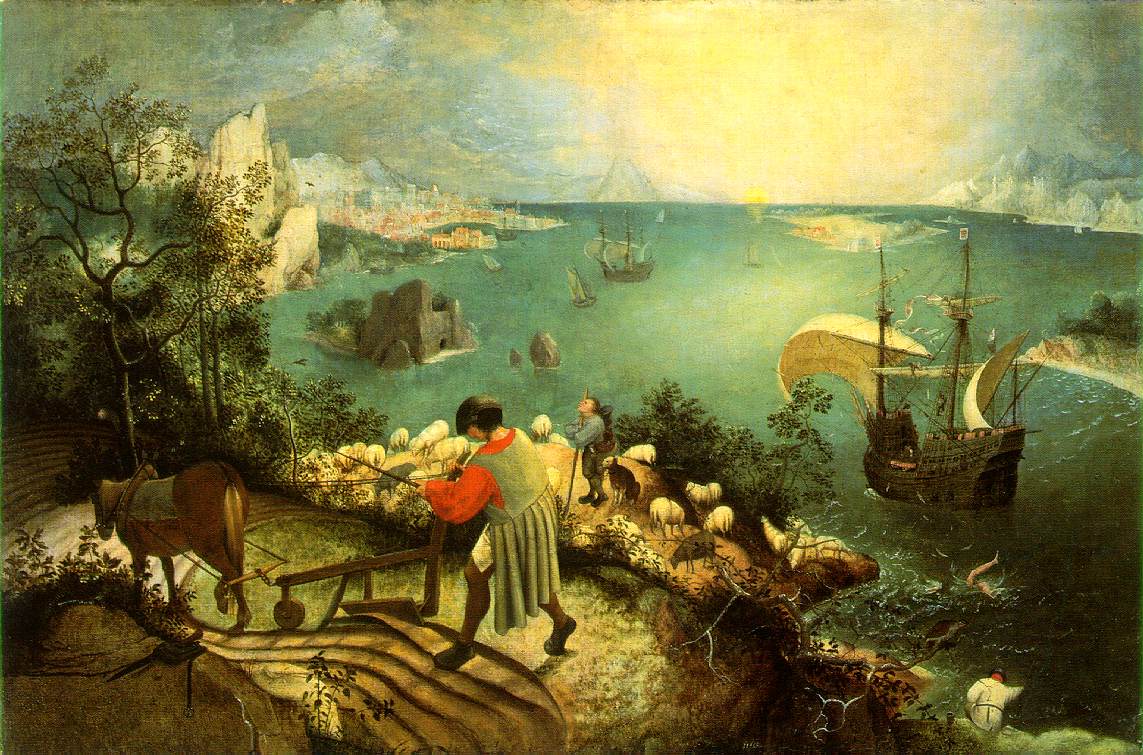
Big news in the Bruegel-sphere this week with new evidence that the famous “Landscape with the Fall of Icarus” is indeed not by Bruegel the Elder. The soon to be released publication, The Brueg(H)el phenomenon, from the Royal Institute for Cultural Heritage (KIK/IRPA) in Brussels, written by Christina Currie and Dominique Allart, puts forward evidence that the painting was painted near the year 1600, decades after Bruegel’s death.
For years scholars have been postulating that this work was not characteristic of Bruegel’s works in several key areas. Manfred Sellink, for example, in his magnificent 2007 monograph “Bruegel: The Complete Paintings, Drawings and Prints,” reviews the history of the attribution question.
The painting has always looked “off” to me. While it was the first Bruegel picture that captured my attention as a 17 year-old student all those year ago, each subsequent viewing of the painting indicated that something was not quite right about it. The most problematic aspect of the painting for me rests in the depiction of the peasant and his horse. The figures do not have the typical heft of Bruegel’s figures. Something about the man and the horse give the impression that they could almost lift off the painting and float into the sky.
The painting is one of the most famous of Bruegel’s works, with W. H. Auden writing an oft-quoted poem about the work.
We look forward to learning more about Currie and Allart’s findings with the release of their research early next year.
Further information here: http://www.codart.nl/news/724/
 BruegelNow