BruegelNow
Bruegel The Elder
Summer Auction Highlights
The summer auction season is upon us, with Christie’s and Sotheby’s offering stellar works by Brueghel the Younger.
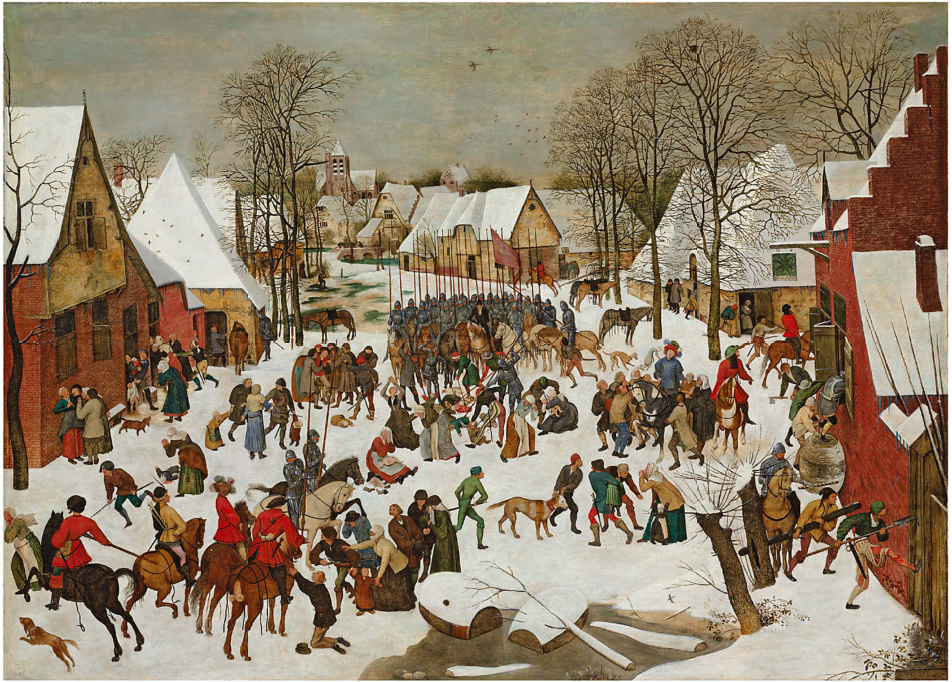
- Massacre of the Innocents
One of most interesting works at auction is the version of “Massacre of the Innocents” at Christie’s. It is interesting for the mystery related to the signature. From the Lot Details:
“The form of the signature on the major versions is considered to be of significance in placing them within the chronologies of Pieter the Elder’s and Pieter the Younger’s oeuvres. The Royal Collection picture is signed ‘BRVEGEL’, which is now accepted as the Elder’s signature; the Vienna version is signed ‘BRVEG’ at the extreme right edge, although the letters ‘EL’ or ‘HEL’ may have been inadvertently trimmed off; a version in Bucharest is signed ‘P. BRVEGEL’. At the time of its sale in Paris in 1979, the present version appears to have born a fragmentary date in addition to the signature, ‘.BRVEGEL. 15..’ (see Campbell, op. cit., p. 15). We are grateful to Christina Currie of KIK/IRPA for noting that the present version is unusual in that it is signed with the signature form of Bruegel the Elder after 1559, ‘.BRVEGEL.’ without an ‘H’ and without the initial ‘P’. No other versions of the Massacre of the Innocents are securely known to be signed in this way; the implications of this for its primacy in the sequence of versions painted by Brueghel the younger remains to be established.”
What happened to the date on the painting? Having the date on the work in 1979 but not present now is mysterious. Was the painting subject to a botched cleaning? Or, did a cleaning reveal that the date was likely false, and was it removed? Hopefully this mystery will be solved soon. Further, it will be very interesting to learn where this version sits in the multiple versions painted by Brueghel.
“Nord on Art” has a great write up of the upcoming Brueghel works at auction:
Brueghel – the Warhol of the Old Master market – UPDATED with sale results
Newly discovered landscape drawing by Pieter Bruegel the Elder on display
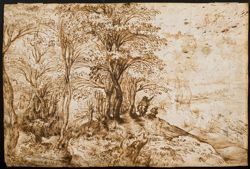
The Museum Mayer van den Bergh made a major announcement related to a new Bruegel drawing. From their news release:
From June 16 through October 14 2012, the Museum Mayer van den Bergh will host the “Pieter Bruegel Unseen! The Hidden Antwerp Collection” exhibition. For the first time ever, the museum will be displaying some 30 prints by Pieter Bruegel the Elder to the general public.
Curator Manfred Sellink, however, has another surprise in store for visitors…
In late 2011, Sellink, curator of the exhibition, Director of Musea Brugge and for years a researcher of Pieter Bruegel the Elder’s body of work, received a photo of a drawing from a private collection. Sellink and Martin Royalton-Kisch, former curator of the British Museum Department of Prints and Drawings, came to the conclusion, after a thorough study, that the landscape drawing belonging to the private collector could indeed be ascribed to Pieter Bruegel the Elder.
Comparisons of the paper type with drawings from the same period and an ultraviolet light test lent weight to their conclusion. For example, it appeared that the newly discovered landscape drawing’s paper was of the same Italian origin as the paper that Bruegel used during his journey to and stay in Italy from 1552 to 1554. In addition, ultraviolet light made traces of a signature visible in the bottom left corner.
The drawing of a mountain landscape with two travellers is the first unknown drawing by Bruegel that has appeared since the 1970s. The landscape drawing has all of the characteristics (composition, image structure and drawing technique) of Bruegel’s self-drawn pieces from the 1552-1555 period (see for comparison the drawings from the British Museum from the same period on the right).
Striking details such as the characteristic way in which the birds are drawn, the manner in which the leaves of the trees are continuously typified by a recurring horizontal “3”, the long parallel shading used to create depth, the manner – as swift as it is accurate – in which the two travellers are shown in the centre, the remarkable way in which the crown of the trees in the background is created using a row of thin strips, the characteristic differences between the foreground’s fluent and sturdy ink-filled pen strokes and the much thinner, more precisely laid-out background… everything points to the drawing being the work of Pieter Bruegel the Elder.
This recently discovered landscape drawing will be on display for the first time ever in the “Pieter Bruegel Unseen! The Hidden Antwerp Collection” at the Museum Mayer van den Bergh starting on June 16, 2012.
Larry Silver’s “Pieter Bruegel”: New Insights On The Old Master

A review of “Pieter Bruegel” by Larry Silver, Abbeville Press, 2011
The images created by Bruegel come thrillingly to life in this Abbeville Press monograph. This handsome volume, written by Larry Silver, Farquhar Professor of Art History at the University of Pennsylvania, puts forward new insights into Bruegel and the time in which he lived. Silver set out to document Bruegel’s output in prints, drawings and paintings by focusing on patterns and areas of interest common to these diverse media. Silver places Bruegel in the social and historical context of his time, as a commentator of the religious and political unrest occurring in the Netherlands during his short lifetime. Silver also includes information not typically found in other Bruegel monographs, documenting the rise of Bruegel scholarship at the end of the nineteenth century, when the new country of Belgium began to look for a native artist to celebrate.
Silver’s first chapter focuses on “Chris Carrying the Cross,” recently made into the fascinating film by Lech Majewski and discussed in a previous blog entry. This chapter is an excellent companion piece to the film, setting Bruegel’s work in the context of Rogier van der Weyden, who lived before Bruegel, as well as Bruegel’s contemporaries such as Joachim Beuckelaer. For Silver, “Christ Carrying the Cross” showcases Bruegel’s range of expression found in his earlier prints, as well as pointing the way to his groundbreaking final paintings, which break with the traditional staging of peasant and religious scenes.
Other chapters cover Bruegel’s life in Antwerp, his prominent patron Nicolaes Jonghelinck and his time with print maker (and future father-in-law) Hieronymus Cock. In a chapter on Bruegel as the “second Bosch,” Silver describes a fascinating transition between the “Bosch” brand, which Bruegel used early in his career, to the “Bruegel” brand, which was not only used by Bruegel but continued by his son and followers for generations.
Silver’s chapters on religion and tradition include an analysis of Bruegel’s ongoing interest in soldiers and weapons, placing Bruegel’s art in the broader context of earlier German images of important battles, such as the Battle of Pavia, which clearly had a significant influence on the artist.
It is inevitable that a Bruegel monograph would include a section on peasant labor and leisure, but Silver manages to put an interesting new spin on this oft covered subject. Building on Alison Stewart’s recent work, Silver shows Bruegel continuing and expanding the tradition of scenes found in German woodcuts. The fascinating scholarly debate between whether Bruegel’s treatment of peasants was sympathetic or moralistically critical is covered well by Silver.
One of the aspects of the monograph that I enjoyed the most was Silver’s careful treatment of lost works by Bruegel that have come down to us through copies by his sons. Silver rightly points out that these lost works deserve robust, careful consideration in the context of original Bruegel’s that survive and should not be discounted as is typical in other Bruegel monographs. Paintings such as “Wedding Procession” and “Visit to a Farmhouse” are two examples where only copies survive, but nevertheless are important components of the Bruegel oeuvre.
The final chapter, which details Bruegel’s legacy, includes an analysis of works by his sons, as well as those who copied or even forged Bruegel’s works. Silver sees this as Bruegel coming to assume a similar status as Bosch, where “Bruegelian” images and themes were adapted and repeated to great commercial success. Silver concludes the monograph by highlighting how no single scholarly consensus has emerged for Bruegel. Rather, he is viewed through the prism of the agendas of scholars who study him.
This monograph is highly recommended.
 BruegelNow