BruegelNow
Pieter Brueghel the Younger
The curious case of a Brueghel the Younger lot estimate
A very nice version of “Wedding Dance in the Open Air” by Pieter Brueghel the Younger is coming up for auction shortly at Christies Paris on November 21, 2024 in the auction “Maîtres Anciens : Peintures – Dessins – Sculptures” (Live auction 23018). (This work is called “The Wedding Dance” in this auction.)

The consensus is that this painting is most likely a copy of a lost work by Brueghel’s father, Pieter Bruegel the Elder. (It is also possible that the composition could be a combination of elements from various wedding dance scenes that his father painted.)
We can’t help but wonder why the estimate is so far removed from the price realized when the lot was last sold 13 years ago. When sold by Sotheby’s New York on June 9, 2011, the price realized was $512,500 on an estimate of $300,000 – $500,000.
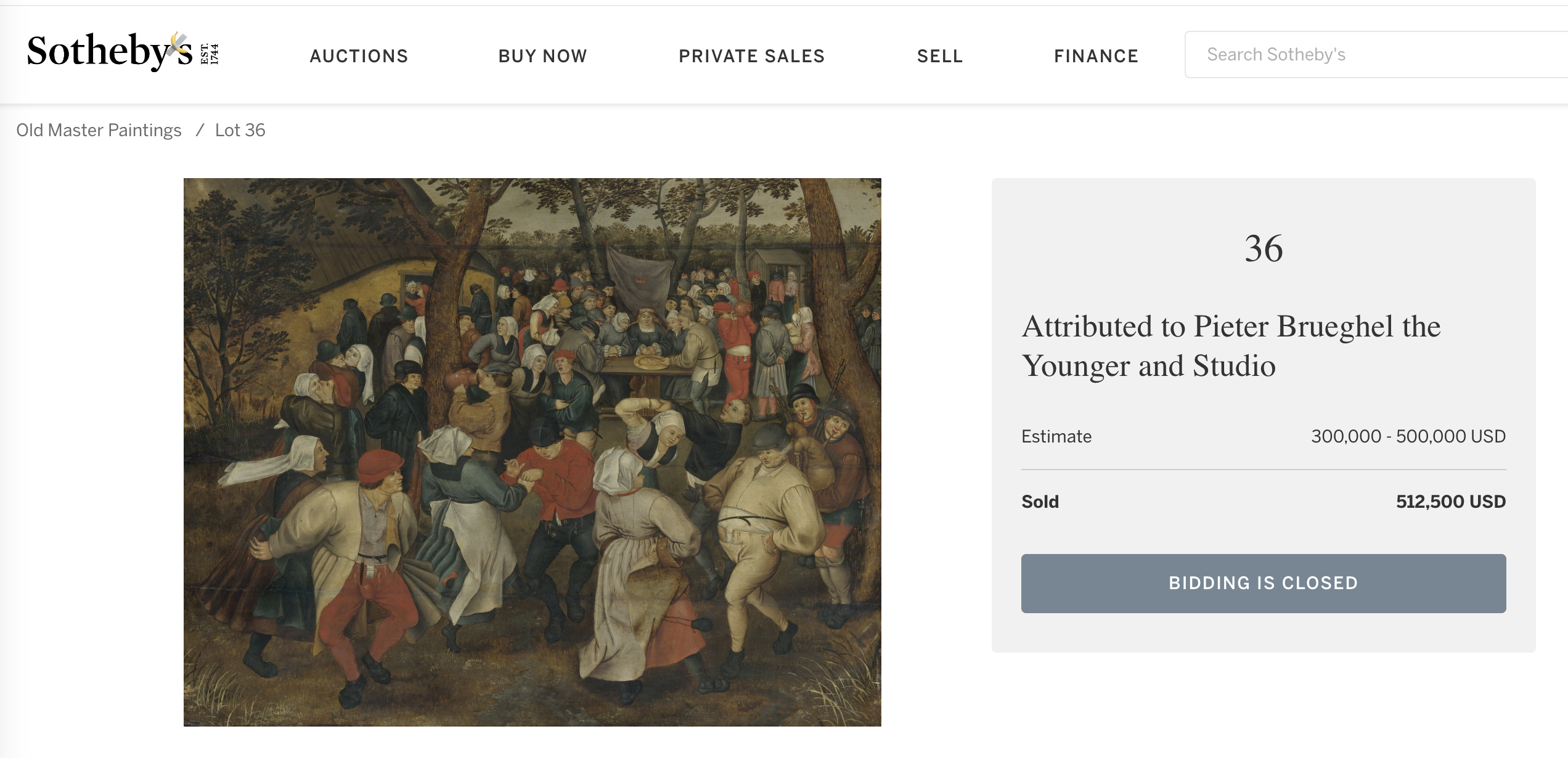
The current estimate for the Christie’s sale is €120,000 – €180,000. Why the lot now carries an estimate 25% – 35% of the price realized in 2011 is puzzling.
While we are not an expert at setting auction estimates, such a low estimate is perplexing. In our experience, wide swings in valuation would typically occur under a few circumstances:
- Change in authorship: While the work was sold in 2011 as “Pieter Brueghel the Younger and Studio,” perhaps it was purchased with the belief that the attribution could be changed to a fully autograph work of Brueghel the Younger. However, since the price realized was not far from the estimate, this appears unlikely.
- Market for the artist’s work: Some artist’s works fluctuate in price due to the artist becoming more (or less) popular. Based on other recent Pieter Brueghel the Younger works at auction over the last few years, interest in the artist continues to be strong, and high prices achieved. It is unlikely that change of interest in Brueghel the Younger’s work resulted in a lower estimate.
- Lack of due diligence / research: As mentioned above, traditionally this work is called “Wedding Dance in the Open Air.” The current work is listed as “La Danse de Noces” (“The Wedding Dance”). Perhaps this is a careless error by Christie’s, who may not have done their research in order to properly name the work. Similarly, Christie’s may not have conducted due diligence to determine how much the work sold for when it was last at auction.
We will be closely watching the outcome of the sale to understand if the €120,000 – €180,000 is an accurate estimate, or if the hammer price will soar to the heights achieved when it was last auctioned.
A Brueghel In 3 Parts

Approximately 150 years ago, a Welsh owner of a large format Pieter Brueghel the Younger paining, “Peasant Wedding Dance in a Barn,” was apparently offended by several images in the painting and chopped the painting into several smaller paintings, removing the offending images from the cut section(s).
The 3 remaining sections of the painting, when superimposed on the large painting, can be seen above. What was cut from the painting are images of a dancing man’s codpiece, a man reaching under a woman’s skirt and other images that must have offended the Welsh owner’s sensibilities.
It is a shame that the Welsh owner took the drastic action of hacking the painting into sections to remove the offending images. Other versions of the work included judicious overpainting, which would have removed the offending images without necessitating cutting the panel into pieces.
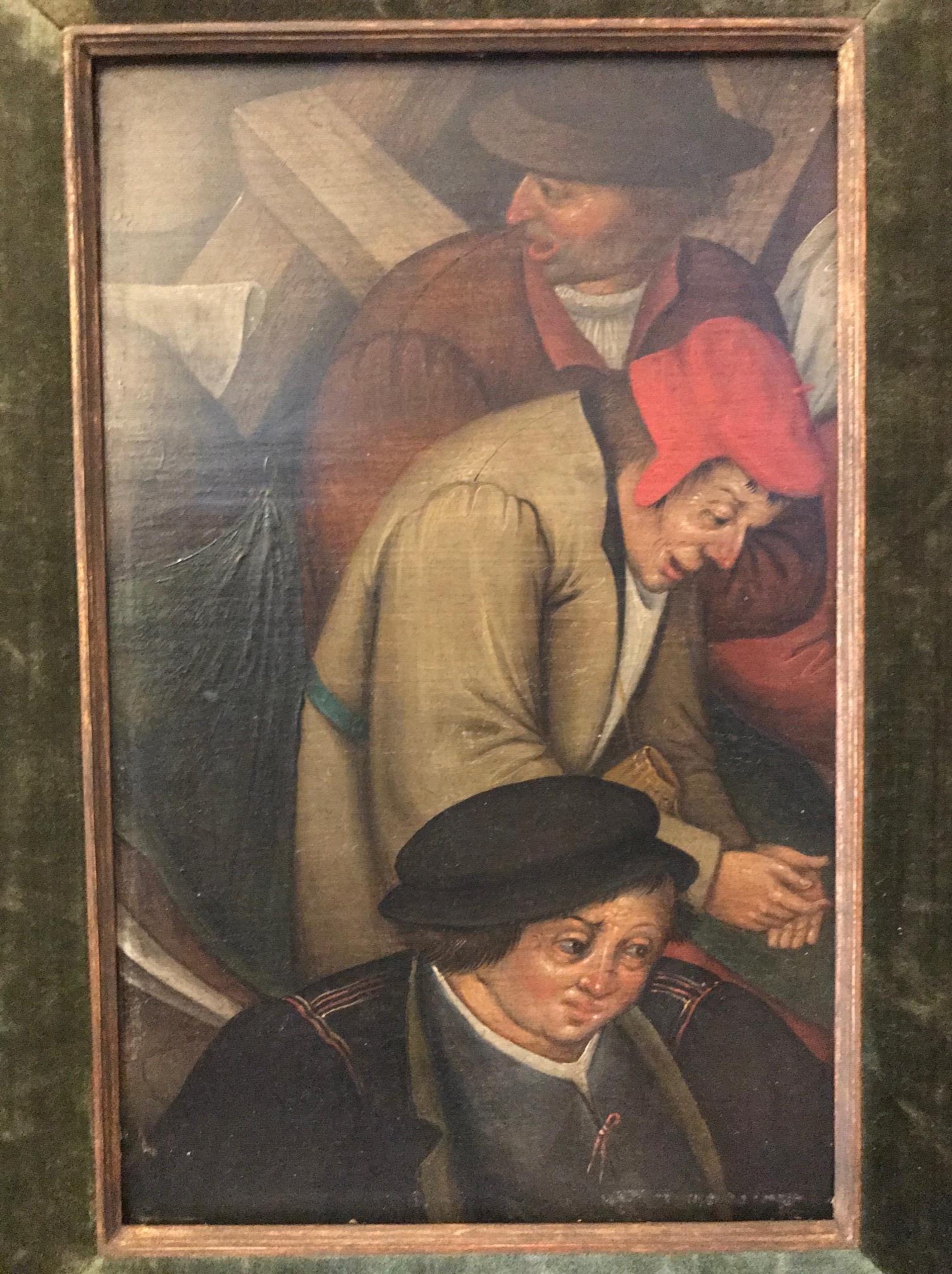
One of the three fragments of the painting recently came to light through a New York auction. This fragment has wonderful colors and careful modeling of facial features. Judging by the attention to detail (such as the delicate rendering of the thread on the dancer’s shirt), this work seems to have been one of the best of the known 27 versions painted by Brueghel the Younger and his workshop. This painting is likely an autograph work by the hand of Brueghel the Younger (see image below).
The back of the panel has both the Antwerp panel maker’s mark in the shape of the Antwerp castle with two hands above and the clover mark of Michael Claessen, the dean of the Antwerp panel makers and a frequent panel maker to Pieter Brueghel the Younger. Both marks point to a specific date range for the painting. The Antwerp panel maker’s mark was used 1619-1638, and Claessen created panels between 1615-1637. Therefore, Brueghel the Younger must have executed this work after 1616 and before 1637.


Since Pieter Brueghel the Younger typically copied works of his father, it is natural to look for the original work painted by his father. Unfortunately, the original work no longer exists or has not yet been identified.
This blog is on a search for the other 2 fragments of this painting. If anyone knows the whereabouts of them, please contact the editor.
Sources for this posting:
Jorgen Wadum, “The Antwerp Brand on Paintings on Panel” in Looking Through Paintings, Emma Hermens, Archetype Books, 2007 (and private correspondence)
Klaus Ertz, Pieter Brueghel der Jüngere 1564–1637/1638. Die Gemälde mit kritischem Oeuvrekatalog, Lingen 1998–2000, (and private correspondence)
Thomas Bodkin, ‘The peasant wedding’, Burlington Magazine 1930 (56), p. 98-105
 BruegelNow