BruegelNow
Brueghel The Younger
The curious case of a Brueghel the Younger lot estimate
A very nice version of “Wedding Dance in the Open Air” by Pieter Brueghel the Younger is coming up for auction shortly at Christies Paris on November 21, 2024 in the auction “Maîtres Anciens : Peintures – Dessins – Sculptures” (Live auction 23018). (This work is called “The Wedding Dance” in this auction.)

The consensus is that this painting is most likely a copy of a lost work by Brueghel’s father, Pieter Bruegel the Elder. (It is also possible that the composition could be a combination of elements from various wedding dance scenes that his father painted.)
We can’t help but wonder why the estimate is so far removed from the price realized when the lot was last sold 13 years ago. When sold by Sotheby’s New York on June 9, 2011, the price realized was $512,500 on an estimate of $300,000 – $500,000.
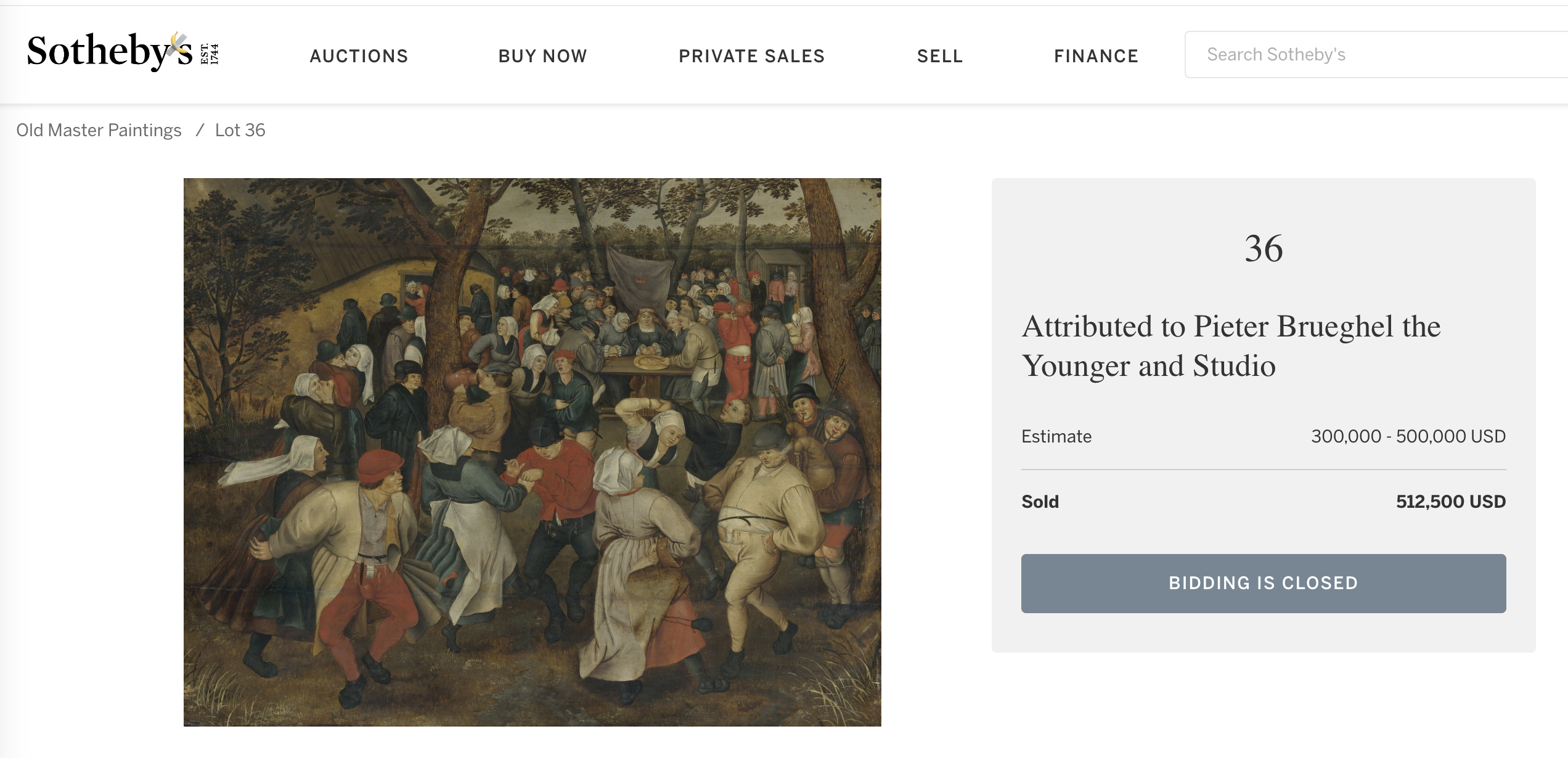
The current estimate for the Christie’s sale is €120,000 – €180,000. Why the lot now carries an estimate 25% – 35% of the price realized in 2011 is puzzling.
While we are not an expert at setting auction estimates, such a low estimate is perplexing. In our experience, wide swings in valuation would typically occur under a few circumstances:
- Change in authorship: While the work was sold in 2011 as “Pieter Brueghel the Younger and Studio,” perhaps it was purchased with the belief that the attribution could be changed to a fully autograph work of Brueghel the Younger. However, since the price realized was not far from the estimate, this appears unlikely.
- Market for the artist’s work: Some artist’s works fluctuate in price due to the artist becoming more (or less) popular. Based on other recent Pieter Brueghel the Younger works at auction over the last few years, interest in the artist continues to be strong, and high prices achieved. It is unlikely that change of interest in Brueghel the Younger’s work resulted in a lower estimate.
- Lack of due diligence / research: As mentioned above, traditionally this work is called “Wedding Dance in the Open Air.” The current work is listed as “La Danse de Noces” (“The Wedding Dance”). Perhaps this is a careless error by Christie’s, who may not have done their research in order to properly name the work. Similarly, Christie’s may not have conducted due diligence to determine how much the work sold for when it was last at auction.
We will be closely watching the outcome of the sale to understand if the €120,000 – €180,000 is an accurate estimate, or if the hammer price will soar to the heights achieved when it was last auctioned.
Brueghel: The Family Reunion
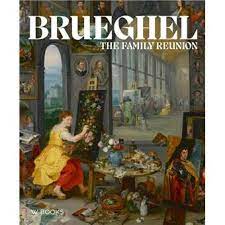
An art museum in ‘s Hertogenbosch, Netherlands, the Het Noordbrabants Museum, is throwing a “family reunion” for the Bruegels / Brueghels. The exhibition, Brueghel: The Family Reunion, covers nearly 200 years of painting from this famous family. The exhibition covers five generations of the Bruegel family, including his sons, grandchildren and mother-in-law. All were influential painters, creating a dynasty throughout the sixteenth and seventeenth century. The family was responsible for the “Bruegel craze” that occurred around 1600, after the most famous member of the family, Pieter Brueghel the Elder, had died. The exhibit is captured in a compelling monograph with wonderful essays published by WBOOKS (www.wbooks.com).
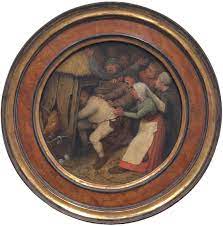
The head of the dynasty, Pieter Bruegel the Elder, is represented in the exhibition by several paintings which seldom leave their home museum. Or, in the case of “The Drunkard Pushed into the Pigsty,” from 1557, are on a rare loan from a private collection.
The role of the women in the Bruegel family is a focus of the monograph. After Pieter Bruegel the Elder died, Pieter the Younger and Jan the Elder, who were very young children, were taught to paint by Bruegel’s mother in law, Mayken Verhulst. Mayken was an artist in her own right, who took over the daily business operations of the workshop of her husband, Pieter Coecke Van Aelst’s, after he died. She not only transferred her artistic knowledge, with documentary evidence showing that she instructed Jan Brueghel the Elder in watercolor painting, but also business knowledge related to how to run a large-scale workshop, which both Pieter the younger and Jan the Elder, did later in life.
The Brueghel family’s interest in the outside world, including elemental and seasonal cycles , depicting plants, animals and weather patterns, can be found in select paintings of the family members. Jan Brueghel the Elder specialized early on in landscapes and the elements. The monograph depicts a series of one of the earliest series, which was so popular it was copied with variations into the 17th century, by not only Jan, but by his son Jan Brueghel the Younger. David Teniers the Younger, the son-in-law of Jan Brueghel the Elder, turned his attention to weather phenomena, and used masterful brushstrokes to evoke emotion.
Paintings of collectors’ cabinets began with Jan Brueghel the Elder and continued for generations, including a fine example by Jan van Kessel included in the monograph. Nearly one-quarter of his surviving oeuvre are depictions of insects. Many works have van Kessel painting the letters of his name in the form of caterpillars and snakes, tying art and nature together. Painters such as Jan Brueghel and Jan van Kessel studied nature and objects with an eye for detail, creating depictions so accurate that they could “seduce and deceive the eye of the viewer.”
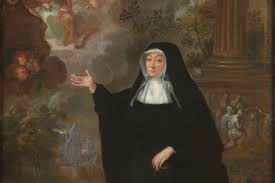
The final chapter of the monograph focuses on women and artistic knowledge in the family, with a focus on Clara Eugenia, eighth child of Jan Brueghel I and Catharina van Marienbergh. Clara Eugenia chose to live her life in a semi-monastic residential community for women. Called Beguines, these communities offered women a supportive alternative to marriage and motherhood. Clara Eugenia took the post of church mistress and served as godmother not only for her brother Jan II’s daughter, but also for Clara Teniers, daughter of her sister Anna and David Teniers II. A wonderful portrait of Clara Eugenia is presented in the exhibit and monograph.
The bright, bright vibrant reproductions of the paintings in the monograph make this an essential work for those interested in the Bruegel family. While viewing the works in person should be a priority for those in the region, for others who are not able to attend (or for those that want a wonderful memento), this monograph is a wonderful substitute.
Klaus Ertz, 1945 – 2023
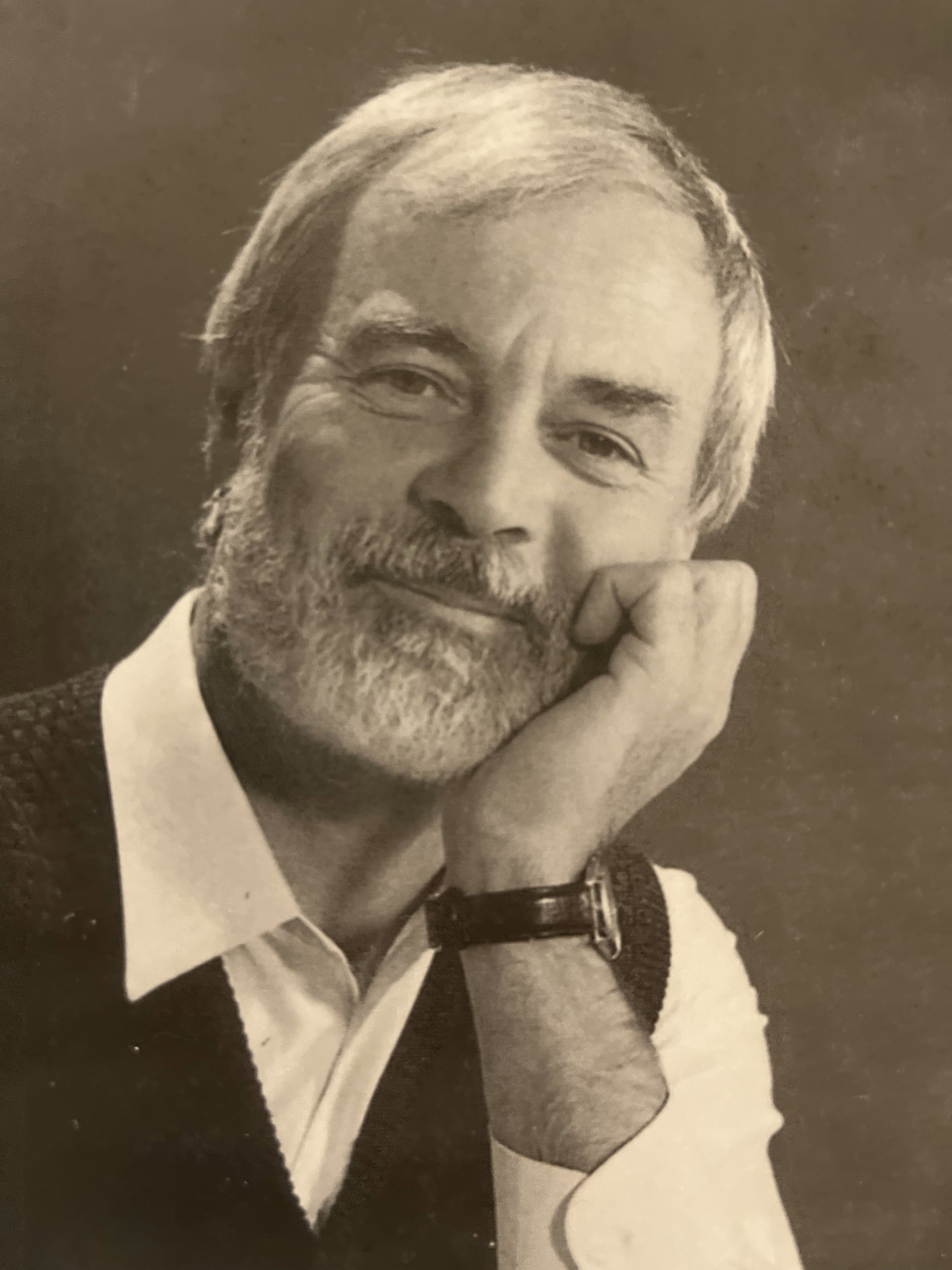
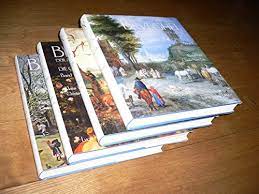
Klaus Ertz, who created catalog raisonnés of members of the Brueghel family and other painters of that era, has died. His death was announced on website of his self publishing company, http://www.luca-verlag.de/publisher. Ertz, and his wife, Christa Nitze-ErtzCristina, spent decades creating catalog raisonnes of members of the Brueghel family, including Jan Brueghel the Elder (1979), Jan Brueghel the Younger (1984) and Pieter Brueghel the Younger (2000, 2 volumes).
The books were carefully created, virtual works of arts themselves. I have always been particulalry impressed by the 2 volumes related to Pieter Brueghel the Younder. The approximately 1,400 works presented over hundreds of pages overflowed with many color images of Bruehgel’s works. For example, Ertz cataloged (with many images) some 127 versions of “Winter Landscape with Ice Skaters and Bird Trap.”
The monographs saught to differentiate autograph works created by Bruehgel the Younger from works primarily by the hands of the many assistents employed in his workshop. Ertz also noted works that were signed and dated.
His greatest impact on the art market was his authentication of works from the Bruehgel family for auction houses like Christie’s, Sotheby’s, Koller and others. The auction houses to bring some level of order to the, if not quite chaos, certainly unclear authorship, of Brueghel’s works. According to a fascinating study (“The Implicit Value of Arts Experts: The Case of Klaus Ertz and Pieter Brueghel the Younger,” Anne-Sophie Radermecker, Victor A. Ginsburgh and Denni Tommasi, January 2017, SSRN Electronic Journal), an Ertz authentication of a work by Pieter Brueghel the Younger increased the work’s value by 60%. While the authentication documents that Ertz created for auction houses were typically short in length, their impact added hundred of thousands of dollars to the sale price of Brueghel-related works. Ertz and the auction houses seemed to have a symbiotic, and very mutually beneficial, relationship.
How Ertz’s death will impact the auction houses, as they will inevitably continue to sell works by Pieter Brueghel the Younger, is an open question. In the brief time since Ertz’s death, only one auction with a Pieter Brueghel the Younger work has been announced (as far as we can ascertain). The work, “The Adoration of the Magi,” was authenticated by Ertz in 2009. Because Ertz authenticated such a large number of paintings during his lifetime, if the owners / auction houses can produce Ertz’s previously created authentication letters, many works will be continue to be sold as verified by Ertz.
Since Ertz began producing his volumes some 40 years ago, many changes have occurred with connoisseurship, catalog raisonnés and their definition and creation. Unsurprisingly, cataloging artist’s works have moved online. For example, a wonderful Jan Brueghel the Elder compendium has been created and overseen by Elizabeth Alice Honig, Professor, University of Maryland, and her team at http://janbrueghel.net/.
As recounted in the Radermecker, Ginsburgh and Tommasi article, expertise in the form of purely visual connoisseurship that Ertz provided has been supplanted by evidence-based technical analysis of the kind applied to the Bruegel family in the groundbreaking volume “The Brueg(H)el Phenomenon: Paintings by Pieter Bruegel the Elder and Pieter Brueghel the Younger” by Christina Currie and Dominique Allart. This is because technical analysis provides stronger grounds for securing authorship than a simple visual review of a painting. However, detailed technical analysis is much more time consuming and expensive, making the proposition of technical analysis becoming commonplace at auction houses unlikely in the short term. How art market authentication of the Brueghel family’s works moves forward in the wake Ertz’s death has yet to be seen.
Book Review: “Peasants and Proverbs: Pieter Brueghel the Younger as Moralist and Entrepreneur”
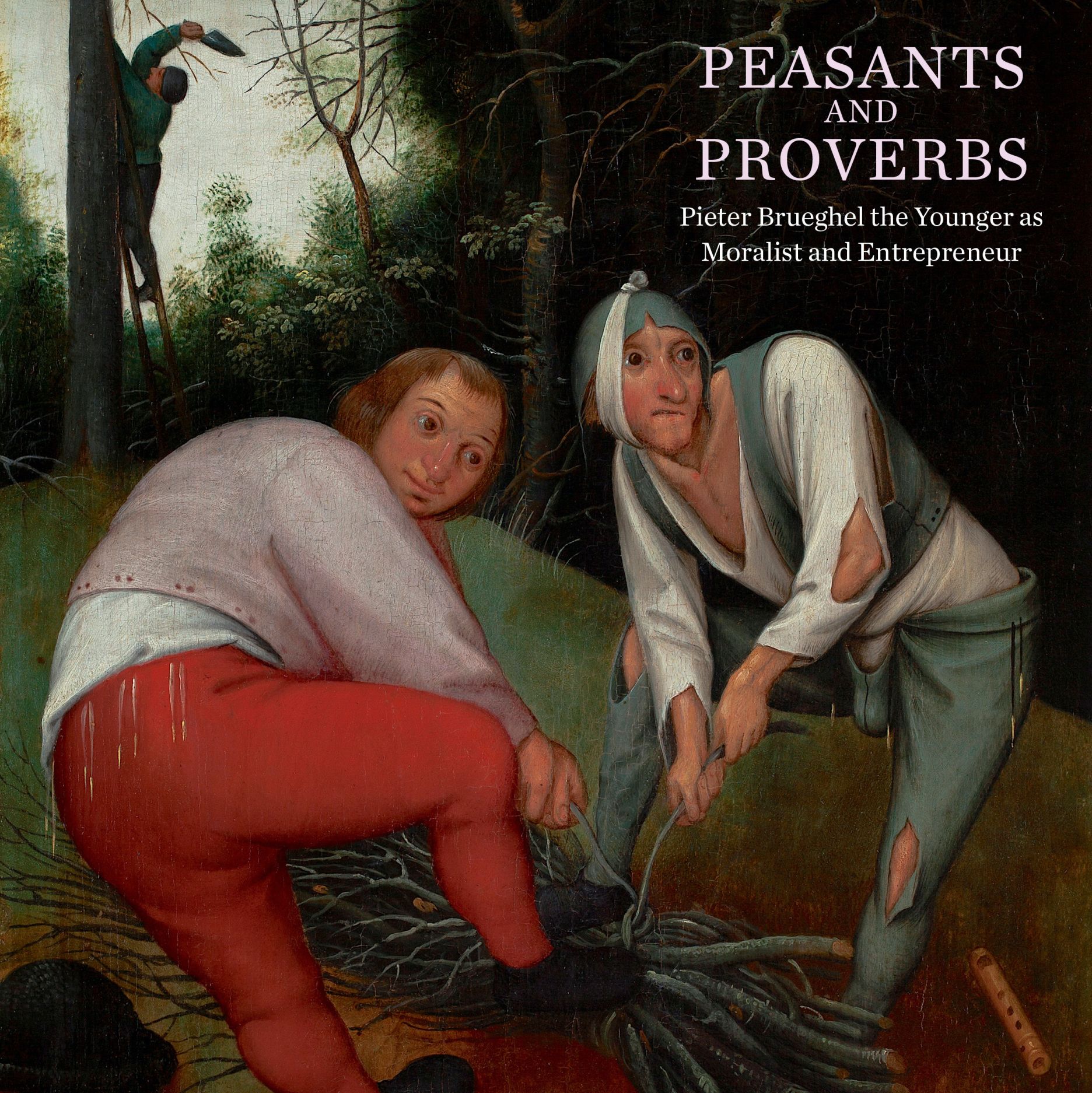
“Peasants and Proverbs: Pieter Brueghel the Younger as Moralist and Entrepreneur” – Edited by Robert Wenley, with Essays by Jamie L. Edwards, Ruth Bubb, and Christina Currie. Published to accompany the exhibition at The Barber Institute of Fine Arts, Birmingham in association with Paul Holberton Publishing.
————————————————————————————————————————————————————-
This volume makes an excellent case regarding why Pieter Bruegel the Elder’s works became popular throughout Europe in the late 16th and early 17th centuries. While Bruegel the Elder’s painted works were primarily in the private collections of the Pope and noble families, his eldest son, Pieter Brueghel the Younger, was producing copies of his father’s compositions for decades. These works were largely bought by middle and upper-class European families, cementing Bruegel/Brueghel’s legacy and furthering the family’s “brand.”
It is rare for a museum exhibition to conduct a deep-dive into a single Brueghel the Younger work, which makes this show (and monograph) especially welcome. The focus is on four works of the same subject, “Two Peasants binding Firewood.” Thought to possibly be a model of a lost painting by Bruegel the Elder, Pieter the Younger painted multiple copies of this work, with four included in this exhibit (three of which are thought to come from Brueghel the Younger and his workshop).
Mysteries surround “Two Peasants binding Firewood.” Why did this subject matter resonate with Europeans at the time? How many versions of the painting were created? How were the copies made? The essays in the monograph seek to answer these questions in fascinating detail.
The book begins with a chapter detailing the life of Pieter Brueghel the Younger. Born in 1564, his famous father, Pieter Bruegel the Elder, died when Pieter the Younger was a young child. Pieter the Younger moved to Antwerp and set up his own independent studio, specializing in reproductions of famous works by his father, as well as original compositions in the Elder Bruegel’s style. Brueghel the Younger was assisted by a rotating group of one or two formal apprentices that entered his workshop every few years. Brueghel the Younger and his assistants produced paintings at high volume throughout his career, with Pieter living a long life, dying in 1637/1638.
The next chapter is Jamie L. Edward’s engaging essay detailing the history of peasants in Bruegel the Elder and Brueghel the Younger’s works. Interestingly, the meaning of the painting at the center of the exhibit, “Two Peasants binding Firewood,” cannot be ascertained with certainty, but can be surmised based on the appearance of similar peasants in other Bruegel works. Of the two peasants prominent in the painting, the tall thin peasant, wearing a bandage around his head, has been identified as a reference to the proverb ‘he has a toothache at someone,’ meaning someone that deceives or is a malingerer. The second peasant, stout and dressed in red pants, represents a stock ‘type’ which can frequently be found in peasant wedding paintings of the time. One likely reading of the painting is that it depicts two peasants who have been caught in the act of stealing firewood.
The chapter by Christina Currie and Ruth Bubb focuses on an analysis of the two other extant rectangular versions of “Two Peasants binding Firewood,” (one from a Belgium private collection and the other at the National Gallery, Prague), comparing them to the version at the Barber Institute. A surprising finding of the dendrochronological analysis of the painting at the Barber Institute found that the tree used to fashion the board used in the painting was cut down between ~1449 and 1481. The authors identify the creator of the panel through a maker’s mark on the reverse of the painting. The panel maker was active from 1589 – c.1621, meaning that the panel was likely painted during this time frame. Interestingly, this means that the tree was stored for well over 100 years before being used by the panel-maker to create the board used by Brueghel the Younger.
Brueghel typically made his works by transferring images via a cartoon to the prepared panel through pouncing, which involved rubbing a small porous bag containing black pigment over holes pricked in an outline of the painting (called a cartoon) onto the prepared blank surface of the panel. The dots that remained were connected via black graphite pencil, and the pigment (dots) wiped away. The paint layer was then placed on top of the underdrawing.
The authors review each of the three rectangular versions, identifying two as autograph versions by Pieter the Younger and his studio. The authors make a compelling case for the version of the painting now in Prague being created outside of Pieter the Younger’s studio. This is due to several reasons, including the lack of underdrawing. The Prague version is also more thickly painted and has relatively crude color-blending in the faces. Some colors in the painting are also different, with light blue rather than pink used for the color of the jacket of the plump peasant.
The final section of the monograph contains the catalog of works in the exhibition. The detailed description and wonderfully-produced images allow the reader to analyze them individually as well as to compare and contrast them. For example, one version of the painting seems to show the thin peasant with his mouth open, showing his few remaining teeth.
Particularly interesting is the smaller, round version of the painting, said to have been painted by Brueghel the Younger later in his career, using free hand, and not a cartoon. This version depicts the two peasants with much smaller heads, in a loose, free-hand manner.
The description of the paintings and their differences is fascinating, with the reader coming away with a good understanding of how the paintings were created and who likely painted them. Readers of the monograph will learn the fascinating history of the Bruegel/Brueghel family along with a compelling explanation regarding how Brueghel the Younger continued and enhanced his family’s reputation in the first part of the 17th century.
Book Review: Anonymous Art at Auction
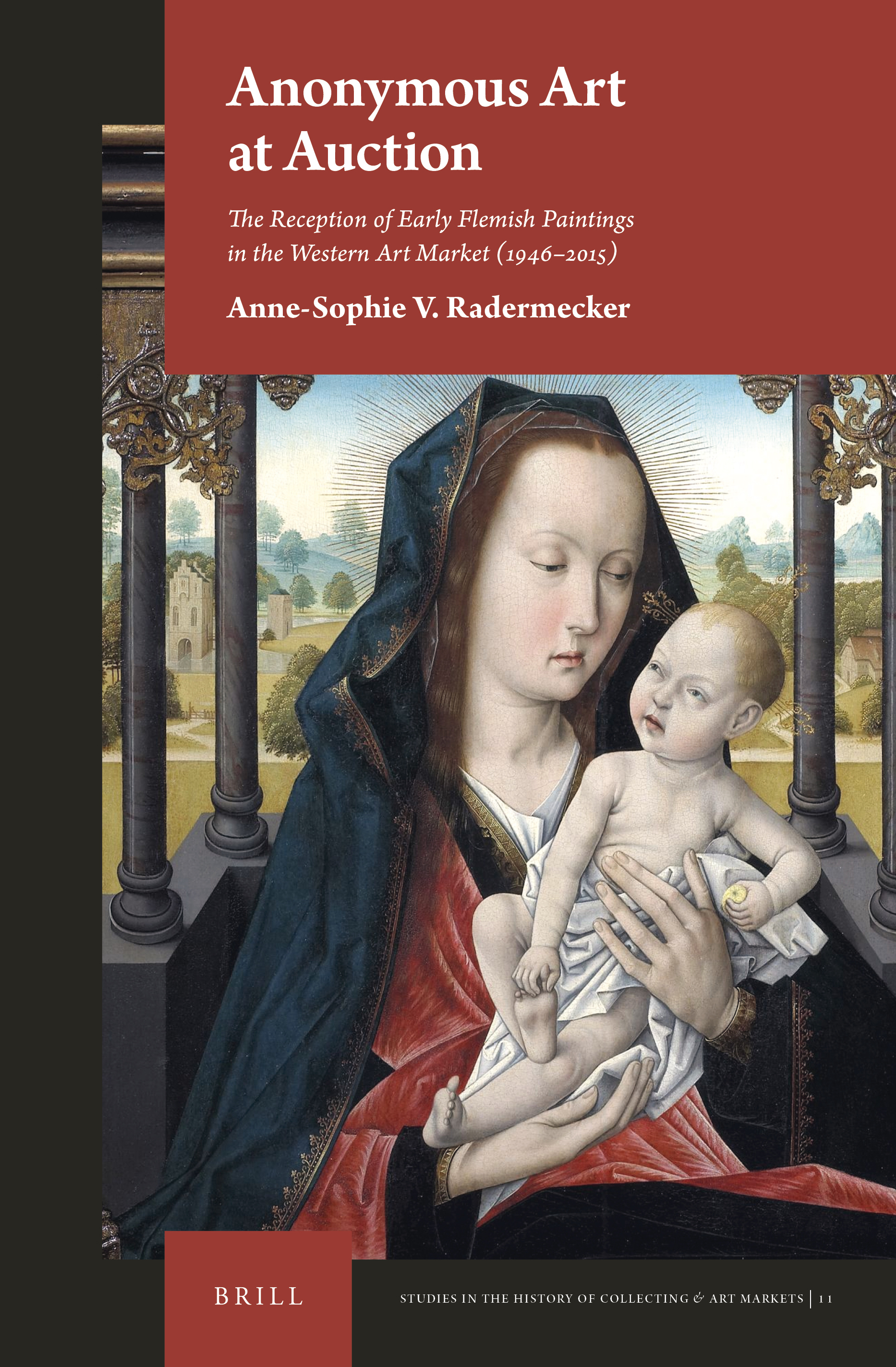
The Reception of Early Flemish Paintings in the Western Art Market (1946–2015) by Anne-Sophie V. Radermecker
“What’s in a name?” Not in the Romeo and Juliet sense, but in terms of old master paintings, we know that an artist’s name is inextricably tied to a work’s market value. A work authenticated as painted by “Pieter Brueghel the Younger” commands a massive premium compared to a work whose authorship is listed as “after Pieter Brueghel the Younger” or “school of Pieter Brueghel the Younger.”
But when a work of art cannot be definitively tied to an artist, are there factors of an anonymous painting that impacts the price the work can command in the marketplace? This question is explored in a fascinating new volume, “Anonymous Art at Auction: The Reception of Early Flemish Paintings in the Western Art Market (1946 – 2015),” by Anne-Sophie V. Radermecker (Brill, 2021). This is a must-read for those who want to better understand the features that impact the market value of anonymous Flemish art.
Radermecker was a co-author of a 2017 article, “The Value Added by Arts Experts: The Case of Klaus Ertz and Pieter Brueghel the Younger,” which researched the impact of an art expert’s opinion on the market price for Brueghel the Younger’s paintings at auction. The authors concluded that when Klaus Ertz, the author of Pieter Brueghel the Younger’s catalog raisonne, provided authentication for a Brueghel work, it had a meaningful impact on the price paid. Buyers paid roughly 60 percent more for works authenticated by Klaus Ertz than works without authentication.
Radermecker’s current monograph makes clear from the outset that an artist’s name is the equivalent of a “brand.” But what about the thousands of paintings for which the artist in unknown? The book details the market reception of indirect names, provisional names, and spatiotemporal designations, which are identification strategies that experts and art historians have developed to overcome anonymity.
Building a brand name during an artist’s lifetime was clearly important, conveying three key attributes: recognition, reputation, and popularity. But because many paintings were not signed, the scholarly community used stand-in authorship titles for works that were painted by the same artist or studio.
These stand-ins for names act as identifiers and play a role in determining a work’s economic value. Example of stand-ins for names include “Master of the female Half-Lengths,” “Master of the Legend of Saint Lucy,” and “Master of the Prado Redemption.” This volume points out that value increases when works are ascribed to a painter, in the form of a stand-in name, when the true author’s name is not known.
By ascribing identities for works without named authors, authorship uncertainty is reduced, and new, alternative brands are created. The reduction of authorship uncertainty leads a buyer to feel more confidence in a work, which adds to buyer’s willingness to pay higher prices. Interestingly, the author suggests that the somewhat haphazard nature of application of name labels over the period of the study (1946 – 2015) was a stumbling block that diminished the efficacy of labels.
The author defines a broad set of stakeholders, including art historians, experts, curators, restorers, dealers, etc., who are involved in proposing and establishing names for otherwise anonymous artists. The author makes the point that while the motives of parties from the scholarly field are not theoretically commercial in nature, they must understand their considerable impact on the market.
Further, Radermecker makes the case for the impact of the scholarly field when ascribing certain works as “significant” or disparaging works by referring to their authors as “minor masters” or “pale copyists.” The role of museums as authorities is discussed in the context of historicizing and legitimizing artistic output. The author argues that museums can place artist brands as well as anonymous artist in context and help the general public understand the value conveyed by artist brands.
The book details the curious fact that an objectively lower-quality work linked to a known artist (and their brand) can command significantly higher price than a higher-quality work that is not connected with secure authorship or artist brand.
Further complicating authorship is the very real studio environment in which Netherlandish artists worked. The old master as a “lonely genius” which solely created paintings is a very nineteenth-century notion and colors the market still today. Research conducted over the past 50 years has shown that most artists did not work alone but were frequently part of a larger workshop. The attribution of many paintings continues to be given to a sole artist when the actual participation of the artist and their workshop often varied greatly.
A case is made for anonymous works providing an alternative artistic experience than those of brand name artists. Without artist’s names, the viewer (and potential buyer) focuses on the physical object and its properties in order to provide an option on the work, which then leads to a value determination.
In an intriguing chapter titled “Paintings without Names,” the market reception of painting that lack all nominal designations was analyzed. A sample of 1,578 auction sales results were put through regression analysis, with the finding that works labeled “Netherlandish” were, on average, 22.6% more expensive than works labeled “Flemish.” Further, works that contain the names of locations where major masters settled and created their work also led to higher valuations. Specifically, works labeled “Antwerp” and “Bruges” commanded +30.6% and +59.2% higher prices. The author concludes that these city names not only function as a location of origin, but also as a label of quality related to the artistic hub.
The author has created a nomenclature made up of eight designations that each had a different impact upon sale price, depending on the specificity of the information provided. Designations specifying a work’s location of production led to prices that are higher on average, as noted above. The author also found that 3 other factors were correlated with higher prices – the work’s state of preservation, the length of catalog notes (which in theory correlate to an expert’s potential involvement) and the mention of earlier attributions.
Radermecker‘s thorough analysis and thought-provoking conclusions provide stakeholders (particularly auction houses) with valuable information to leverage when working to maximize the price paid for anonymous artworks.
“Children’s Games” Variant – What Do We Know?
Over the past few months we have had an opportunity to study an interesting “Children’s Games” variant.
We have studied the infrared reflectography image taken, as well as an X-ray image and several images created with various light and dark shading.
Let’s review the images and discus what they reveal about the painting:
First, this image (below) clearly indicates that the painting is quite dirty through age and discoloration of varnish.

This image (below) with light raking from the right side make clear the few small places on the painting which have been cleaned, so the bright colors of the original panel come through, such as in the upper right corner where the sky has been cleaned and the middle left, where the young girl has been cleaned.

An ultraviolet light image (below) shows clearly some of the damage to the painting that has occurred over the decades. The most pronounced damage is along edge where the first and second panels were joined together. There also is damage in the middle of the painting with a few scratches.

One of the mysteries that we are trying to solve with this analysis is to determine when the painting was created. The image below of raking light on the back of the painting clearly shows that the 3 boards which comprise the painting were created with saw-type tools, and don’t appear to be created by a machine.
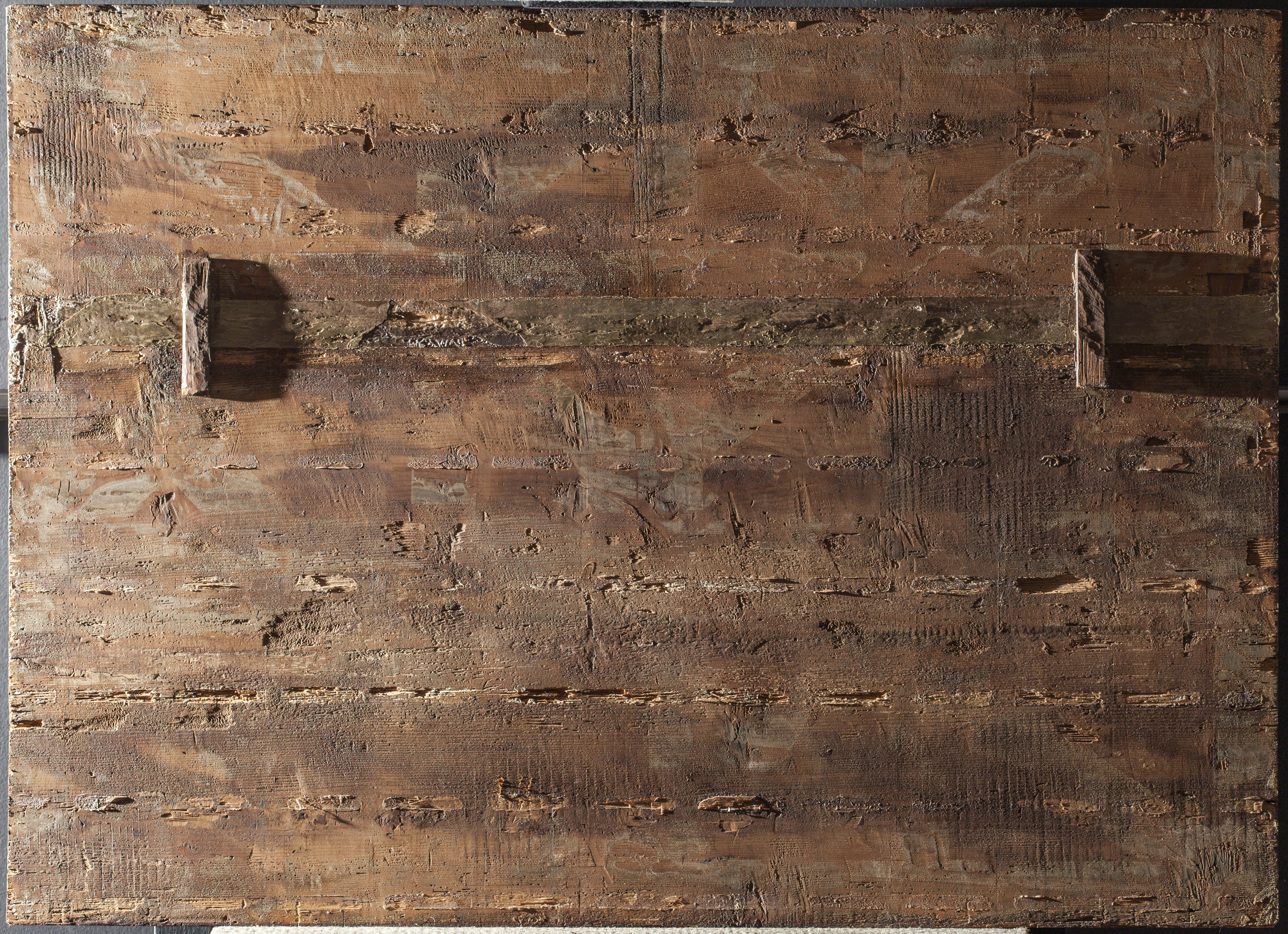
A recently published monograph “Frames and supports in 15th- and 16th-century southern netherlandish painting” by Hélène Verougstraete has been instructive in our analysis of the marks on the back of the panel. This has been instructive relative to how the panel was created. While none of the images in the monograph are an exact match, some, such as the figure a (page 33) appear to be somewhat close.
However, we aren’t able to date the panel with certainty based on this information.

The image below clearly shows the repair that panel has undergone, most noticeably the increased support that the panel has had to repair and support the joining of the first two panels, where the damage in the other panels can readily be seen.
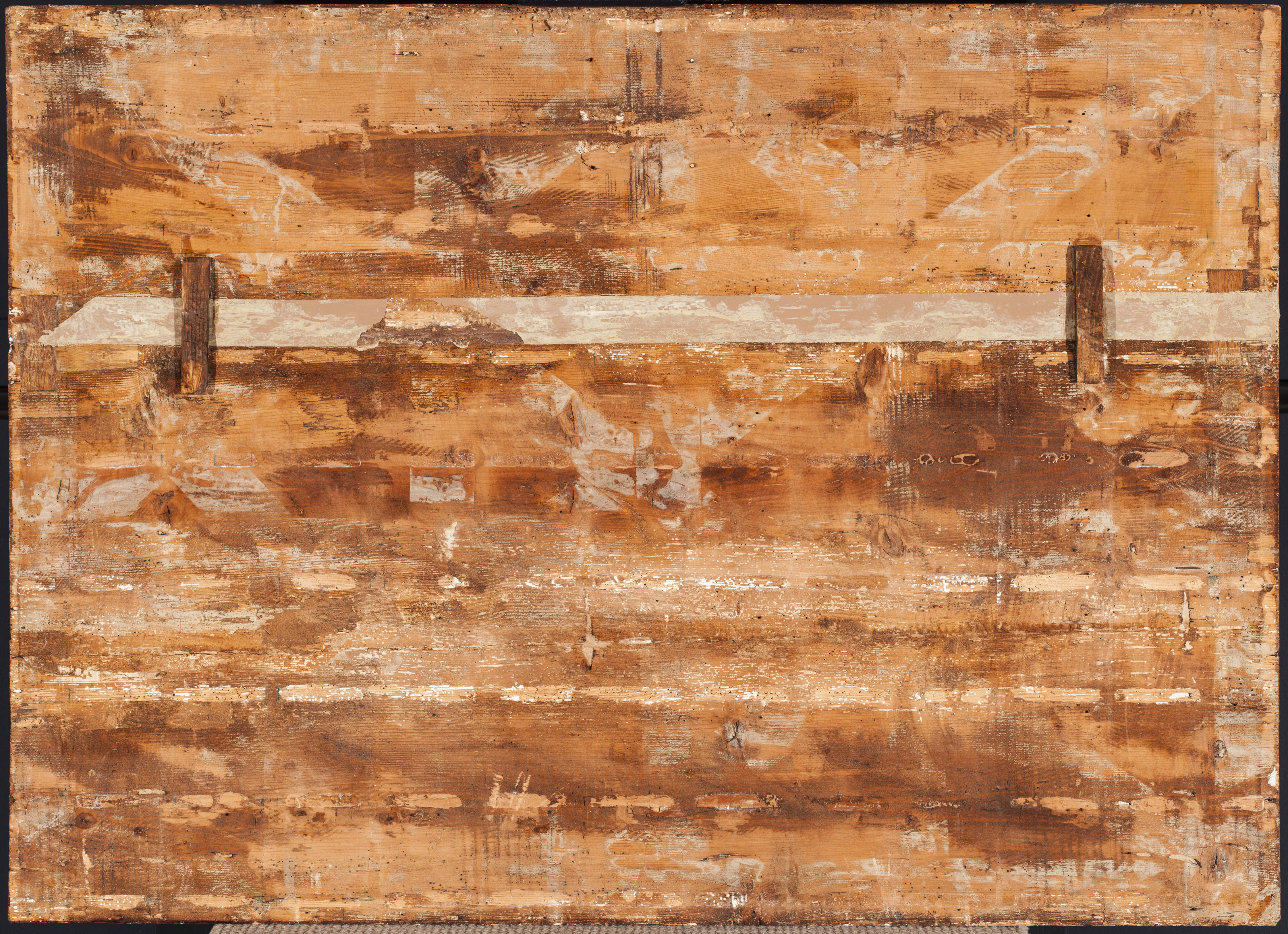
We are continuing to examine this panel and look forward to sharing our findings here!
Summer Auction Highlights
The summer auction season is upon us, with Christie’s and Sotheby’s offering stellar works by Brueghel the Younger.
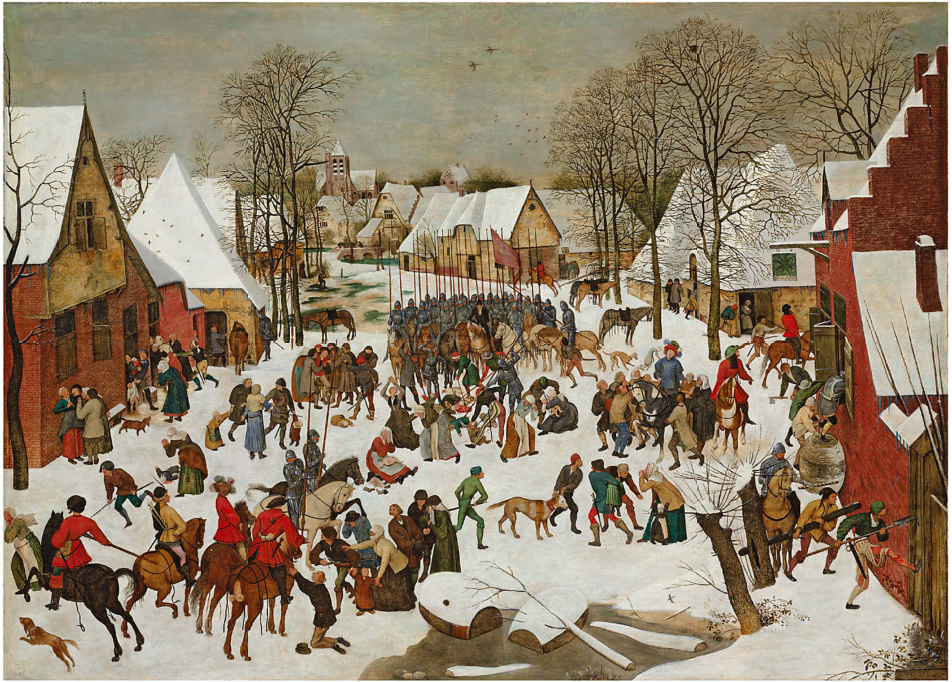
- Massacre of the Innocents
One of most interesting works at auction is the version of “Massacre of the Innocents” at Christie’s. It is interesting for the mystery related to the signature. From the Lot Details:
“The form of the signature on the major versions is considered to be of significance in placing them within the chronologies of Pieter the Elder’s and Pieter the Younger’s oeuvres. The Royal Collection picture is signed ‘BRVEGEL’, which is now accepted as the Elder’s signature; the Vienna version is signed ‘BRVEG’ at the extreme right edge, although the letters ‘EL’ or ‘HEL’ may have been inadvertently trimmed off; a version in Bucharest is signed ‘P. BRVEGEL’. At the time of its sale in Paris in 1979, the present version appears to have born a fragmentary date in addition to the signature, ‘.BRVEGEL. 15..’ (see Campbell, op. cit., p. 15). We are grateful to Christina Currie of KIK/IRPA for noting that the present version is unusual in that it is signed with the signature form of Bruegel the Elder after 1559, ‘.BRVEGEL.’ without an ‘H’ and without the initial ‘P’. No other versions of the Massacre of the Innocents are securely known to be signed in this way; the implications of this for its primacy in the sequence of versions painted by Brueghel the younger remains to be established.”
What happened to the date on the painting? Having the date on the work in 1979 but not present now is mysterious. Was the painting subject to a botched cleaning? Or, did a cleaning reveal that the date was likely false, and was it removed? Hopefully this mystery will be solved soon. Further, it will be very interesting to learn where this version sits in the multiple versions painted by Brueghel.
“Nord on Art” has a great write up of the upcoming Brueghel works at auction:
Brueghel – the Warhol of the Old Master market – UPDATED with sale results
Brueghel Auction Update – Fall 2011

There was big news in the Bruegel-verse, with the fall 2011 auction season generating a new record for a price paid for a Brueghel the Younger painting. Brueghel expert Klaus Ertz called the version of “The Battle Between Carnival and Lent” which was sold “of masterly quality”, which certainly helped the work achieve a the record price of £6,873,250.
Of this sale, the New York Times’ Souren Melikian said:
“In the days of abundance, Pieter Brueghel the Younger’s vast allegory “The Battle Between Carnival and Lent” would not have aroused wild enthusiasm. No fewer than five versions of the subject have been recorded, of which three are from the painter’s own hand. These are not even original but are interpretations of Pieter Brueghel the Elder’s composition. On Dec. 7, 2006, “The Battle Between Carnival and Lent” cost £3.26 million at Christie’s. On Tuesday it rose to £6.87 million. The easy, large Brueghelian image appeals to a new generation of bidders loath to spend much time parsing the subtleties of great masters, whether in compositional inventiveness or the brilliance of brushwork.”
(NYT, 12/9/2011)
 BruegelNow