BruegelNow
Uncategorized
The Value of Attribution – A Brueghel Case study and a Potential $350K Payday
It comes to no surprise to any collector that a firm attribution to an painter positively impacts a painting’s value. But what does this mean in the world of Bruegel / Brueghel? The recent attribution of “Wine on St. Martin’s Day” to Bruegel the Elder from a previous attribution of Brueghel the Younger catipulted this painting’s value to 25M Euros if sold on the open market (1). An upcoming auction for Brueghel the Younger’s “The Wedding Dance” at Palais Dorotheum on October 21, 2014 will test the value of attribution for his son, in one of Bruegel / Brueghel’s most popular painting motifs.
In February of last year at rather rough looking painting of “The Wedding Dance” was put up for auction at Bill Hood and Sons in Florida in the USA.
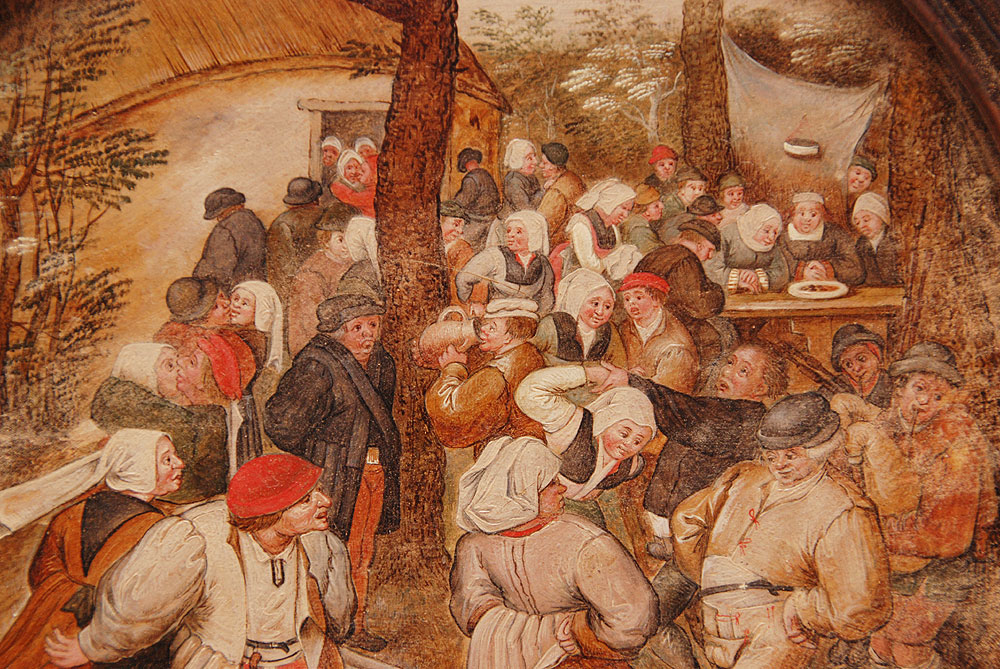
This work, “attributed to Brueghel the Younger” was estimated at $10,000, but on the day of the auction soared above the estimate to land at a sale price of $21,000.
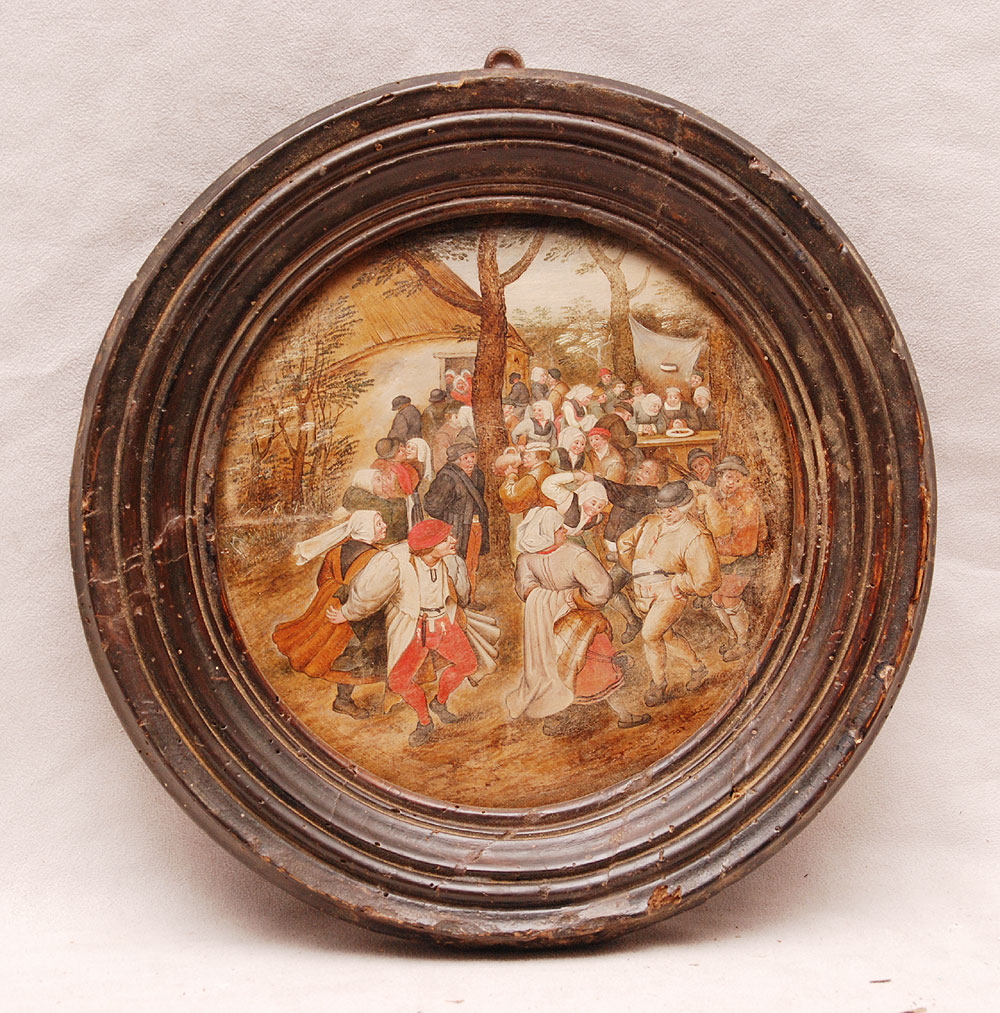
In the time since the auction, the painting was carefully restored, and the owner (or Palais Dorotheum, the seller) worked with the preminant scholar in the area of Brueghel the Younger, Klaus Ertz, to determine whether the work was an autograph Brueghel the Younger.
The Dorotheum website explains the attribution, “The present painting was analysed using X-ray technology and infrared reflectology. The analysis found that the pigment matched that usually used by Pieter Brueghel the Younger. Furthermore, the manner of working is that of Pieter Brueghel; the wooden panel was prepared using a white chalk base and the imprimatura was applied on the diagonal using a wide brush, as is the case with most of Brueghel’s paintings. The entire composition was meticulously sketched on to the prepared panel. In the underdrawing there are multiple pentimenti.” (The phrase “meticulously sketched” is interesting, since Christina Currie and Dominique Allart in “The Brueg(h)el Phenomenon” show that Brueghel the Younger and his workshop typically used pouncing to transfer images from the preparatory cartoon to the surface of the paining. Hopefully Currie and Allart can examine this painting to tell us more about how the image was tranferred, since it is only one of two examples of this scene in round (“tondi”) form.)

The Dorotheum description concludes by stating, “The present painting is of an exceedingly high quality and should be considered among Pieter Brueghel the Younger’s masterpieces.”
In other words, the attribution raises the price from $21,000 to up to $378,000 (the high end of the sales estimate, which I think this painting will achieve.)
Below is an image of the restored patining on sale at the auction.
Happy bidding!!
(1) http://www.bbc.co.uk/news/world-europe-11402594
Bruegel’s Mirror – Exhibition
A wonderful new exhibition at the Royal Cornwall Museum from September 20 to November 8 2014 explores Bruegel the Elder via art created by Laurence Smith.

From the introduction:
Pieter Bruegel the Elder (c.1525-1569) was a Flemish artist who illustrated
people’s everyday lives and the worlds they inhabited. His work is often seen
as being one of the earliest forms of social satire in art history.
In the drawing Nobody and Somebody (1558) the character of Nobody
is shown staring at himself in a mirror, below Bruegel has written the line
“Nobody looks at himself”. Bruegel loved to turn proverbs into pictures and in
doing so held his own mirror up to what he saw as the foolishness of society.
Bruegel was predominantly known for his large, colourful oil paintings of, what
were known as, ‘peasant scenes’. These were commissioned by wealthy
patrons and rarely seen in public. However, many of his drawings were made
into engravings allowing them to be reproduced and seen by a far wider
audience.
Laurence Smith has made a study of Bruegel’s little known graphic works and
turned some of these drawings and engravings into oil paintings whilst trying
to mirror the colour and energy of Bruegel’s paintings. Enlarged and vividly
coloured Bruegel’s highly detailed graphic images can now be seen like never
before.
Pieter Bruegel the Elder wanted to hold up a theatrical mirror in order for us to
see our own selves, with all our virtues and vices, reflected back at us.
Brueghel in the Broom Closet

Of course it is not unusual to find a Brueghel painting in a public art collection, or in a private museum, or, increasingly, in the residence of a wealthy citizen of Russia. What is unusual is finding a Brueghel in an out of the way location. In what is perhaps the strangest setting in which I’ve seen a Bruegel, recently I visited the Church of Saint-Severin Paris’ Latin Quarter knowing that this church had a large format Brueghel, The Crucifixion.
Upon entering the typically fairly dark interior of the Roman Catholic church, I scanned the walls for the painting. I wasn’t surprised that I did not see it, since I expected that it might be in one of the small chapels of the church.
After circling the church several times and not seeing the painting, I noticed an open door into a sort of closet, or anti-chamber, where there was activity. It appeared that the church was preparing for a concert performance.
Amid the activity I stepped into the small room, scanned the walls, and much to my surprise, just above the door to another room, was the painting. It hung approximately 15 feet above floor level and gleamed luminously. While members of the choir were running in and out of the room, I stood back and took in the painting. It was fantastic, large, and had the attributes of a typical Brueghel work.

The painting is similar to other versions of the painting, showing Christ and two others being crucified in a large format landscape. A city extends further in the distance with the temple of Jerusalem. A field of wheat can be viewed behind the figure on the left. In the background two peaks can be seen connected by a natural bridge. Marlier notes that in this version of the painting, the sky is darker than in other versions. It is thought that this painting is a copy after a lost work by the elder Bruegel.
As the activity in the small church room was dying down, it appeared that a concert performer was preparing to lock the door and wanted me to leave. I exited the room, and the door was closed behind me.
I wondered if my visit hadn’t coincided with musicians preparing for a performance, if I would have been able to see the painting. It seemed like the door to this room was normally closed, and only happened to be open because of the performers preparing for the concert.
In life, as with seeing Bruegel/Brueghel paintings, timing is everything. Particularly when there is a Brueghel in a broom closet-like setting.
Two Outstanding Bruegel-Related Paris Galleries: Galerie D’Art Saint-Honoré and De Jonckheere Gallery
Paris is home to the only two galleries that specialize in work by the family of Bruegel. For those interested in Brueghel, these galleries are “can’t miss” opportunities. Fortunately, during a visit to Paris earlier this year, I was able to tour both galleries.
Galerie D’Art Saint-Honoré
The Galerie has been in existence since 1984 when it was established by Monika Kruch. I spent a wonderful afternoon with Jérôme Montcouquiol discussing the Galerie and all things Bruegel.
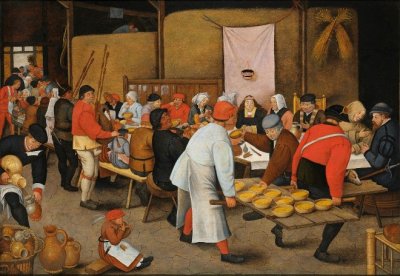
Mr. Montcouquiol discussed with me the recently concluded and very well received exhibit “The Brueghel Dynasty”. The exhibit not only included works from the Galerie, but several private collections contributed works to the exhibit. Included in the exhibit were works from by Jan the Elder, Jan the Younger, Pieter the Younger and others. A highlight of the exhibit, and a work that can be seen in the Gallery, is “The Wedding Feast.” This version differs from many others (and differs from the version painted by Bruegel the Elder) in that two figures can be seen in the loft in the top left portion of the painting.
We spoke about the Galerie’s upcoming exhibition in the Maastricht, Netherlands art fair, where the gallery exhibits each year. Mr. Montcouquiol indicated that they are looking forward to another outstanding show.
The gallery only acquires works of exceptional quality, and strives to showcase works of the Brueghel family as well as major works of other artists of the period.
Galerie De Jonckheere
Paris is one of two locations for Galerie De Jonckheere. This galerie has been catering to Bruegel-related collectors for nearly 40 years. I spent a lovely hour in the Galerie speaking with the staff. The Galerie has had both large scale and more intimate Bruegel-related works, including a wonderful version of the Peasant Wedding Dance by Pieter the Younger (see below). Collectors from North America, Europe and increasingly Russia frequent this gallery to view the latest additions to its collections.
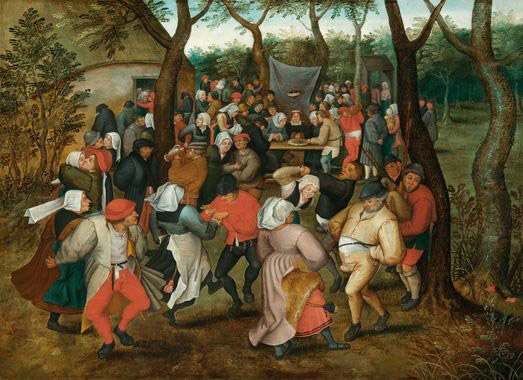
Like many galleries, locating quality Bruegel-related works is difficult in this internet-connected environment. After a new work is acquired, it is reviewed and cleaned to the gallery’s exacting specifications. The works gracing the Galerie’s walls are of the highest standard.
The Galerie has experimented with exhibiting in New York (MANE) as a way to exposure new collectors to its work. This sounds like an ideal way to ensure that new collectors are aware of the magnificence of the Bruegel family.
The Galerie uses its own expertise, with the extensive expertise of Georges and François De Jonckheere, as well as occasionally calling in experts to authenticate works.
In conclusion, both galleries offer outstanding works and are well worth a visit when in Paris. If you aren’t able to visit Paris, the galleries have wonderful websites that can provide a fine view of the current paintings on offer.
Galerie D’Art Saint-Honoré: http://www.art-st-honore.com/en/
De Jonckheere Gallery: http://www.dejonckheere-gallery.com
Brueghels in the Bunker
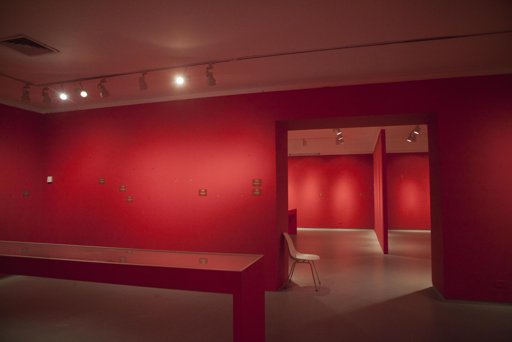
TEL AVIV, Israel (AP) — The wine-red walls of the Brueghel exhibition hall at the Tel Aviv Museum of Art are now bare, like the crime scene of a daring art heist.
Tel Aviv’s leading art museum, spooked by rocket attacks on Israel’s cultural capital, moved nearly 200 works Friday into a rocket-proof safe the size of an auditorium — including some 100 works painted by relatives of Flemish Renaissance master Pieter Brueghel the Elder.
“Even if there’s a very small possibility (of damage), we don’t play around. We don’t take chances,” said Doron J. Lurie, the senior curator and chief conservator. “We’ve guarded them like our own kids.”
One other Israeli art museum followed suit, hauling some of its most prized artworks into fortified vaults deep underground to protect them from the current round of Israel-Palestinian fighting. For nearly a week, the Israeli military has waged air strikes against Gaza, while Palestinian militants have barraged Israel with rocket fire.
In the southern city of Ashdod, which has suffered more frequent rocket barrages because of its proximity to Gaza, the curator of the Ashdod Art Museum — Monart Center took down 15 works of leading contemporary Israeli artist Tsibi Geva. On Sunday, he stashed them in a vault four floors underground designed to withstand rocket fire and biological weapons.
“It’s chutzpah to take a chance on them,” said curator Yuval Biton, using the Yiddish word for “audacious.” It was the first time the Ashdod museum had hid its art in the vault since it opened in 2003.
Israel has seen its fair share of incoming fire over the past decade: Hezbollah launched rockets that rained down during the 2006 Lebanon war, and rockets from Gaza have repeatedly been fired into Israel’s south.
During fighting in Gaza four years ago, the art museum in the southern city of Beersheba moved works from unfortified storage to a reinforced vault in city hall, said Idit Amihai, the top government official in charge of museums.
But most of Israel’s leading museums in the heartland cities of Jerusalem and Tel Aviv — far from traditional rocket range — have had little reason to fortify artworks in the past.
Even during the current fighting, not all museums have rushed to protect their treasures. The Eretz Israel Museum in Tel Aviv, which displays Near Eastern antiquities and other art, left its works in place. “We don’t get into a panic and take stuff from the glass showcases,” museum spokeswoman Miri Tsedaka said.
And, despite one instance of rockets aimed toward Jerusalem that landed south of the city, no extra security precautions have been taken at the Israel Museum in Jerusalem, the country’s central museum housing its most prized antiquities and cultural possessions. “It’s business as usual,” said director James Snyder.
Lenny Wolfe, a prominent Jerusalem antiquities dealer, said he hasn’t moved his valuable ancient objects from his bank’s safe deposit box. “I’m more concerned about my own safety and the safety of my own family than a few bits of pottery,” Wolfe said.
The only other time the Tel Aviv museum rushed to save its works was during the 1991 Gulf War, when Iraqi Scud missiles pounded the seaside metropolis. At that time, the museum whisked its entire collection of paintings and sculptures into its large vault.
The works that were moved into the safe on Friday include one of the Jewish world’s most iconic paintings — Polish artist Maurycy Gottlieb’s 1878 work, “Jews Praying in the Synagogue on Yom Kippur” — as well as some 100 works by sons and relatives of Pieter Brueghel the Elder, and one precious painting by the master himself, the mid-16th century “The Resurrection of Christ.”
The Brueghel exhibit had already been crippled by Israel’s image as a dangerous place, said the curator, Lurie. He knew museums wouldn’t lend him many works by Brueghel himself, so he focused on persuading museums and collectors to lend him works by Brueghel’s descendants.
Then, a month before the “All His Sons: The Brueghel Dynasty” exhibition opened in August, two foreign museums backed down on their promise to loan two important paintings by the Flemish master’s sons because of heightened talk of a possible Iran-Israel war, Lurie said.
“‘Are you serious that you’re asking for this painting for summer 2012?'” Lurie recalled museum representatives telling him.
Now the exhibition’s works are behind a heavy, hulking metal door with an outsized combination lock. Wearing white gloves, Lurie turned a large silver wheel in the middle of the door and struggled to pull it open to show some of the stored paintings.
Despite concerns about the risks, top masterworks are frequently exhibited in Israeli museums on loan from world institutions and collectors. Displaying masterpieces is a trickier proposition in the West Bank: It took yearlong negotiations with Israel’s army and Dutch museum officials to get a $7 million Pablo Picasso masterpiece safely into a West Bank gallery in 2011.
Only a few rockets have whistled over the skies of Tel Aviv during the current conflict, and the city is considered safer than other Israeli towns along the Gaza border. So the Tel Aviv museum let southern Israelis visit the museum for free — and reduced admission for everyone else to account for the 200 or so missing spots on the museum walls. The Israel Museum and Eretz Israel Museum also offered free and discounted entry.
The works moved into the safes in Tel Aviv and Ashdod were mostly pieces on loan from private collectors.
“If they survived 800 years before they got here, we have to do the utmost, for the good of humanity, so they will survive at least another 500 years,” said Lurie.
————————————————————-
Original Article here: http://news.yahoo.com/israel-museums-hide-art-protect-rockets-213242859.html
Exhibition: Bosch & Bruegel Four Paintings Magnified
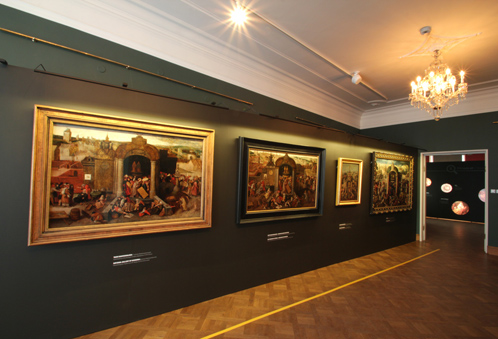
Bosch Bruegel Exhibit
Years ago, while visiting the National Gallery of Denmark, I was stopped in my tracks as I came across a painting identified as a Bruegel the Elder work. I wasn’t floored so much for the painting’s beauty, but my mouth hung open because I had never seen it or heard of it before. The painting, “Christ Driving the Money-Lenders From the Temple,” was listed in none of my many Bruegel monographs. How could this be? I wondered. How can a museum hang a work and call it “Bruegel” when everyone else in the world doesn’t agree that it is a Bruegel?
Currently a fascinating exhibit covering the painting is underway. Tracing Bosch and Bruegel: Four Paintings Magnified investigates four similar paintings that are done in the Bosch style, which was also emulated by Bruegel in his earlier paintings. The exhibit seeks to answer the questions of who painted the works and when were they painted. Further, how did these four very different paintings of essentially the same scene come to hang in the three galleries and one private collection?
While my specific question regarding the labeling of the Copenhagen painting isn’t answered in the exhibit, it does provide countless other fascinating details. You can learn more about the exhibit at the excellent website: http://www.bosch-bruegel.com. The creators of the website should be applauded at their exceptional work. While I am not likely to see the exhibit in any of the locations to which it travels, I feel as if I have experienced it due to the wealth of information provided on the web. In addition, at least two conferences and a monograph are planned around the exhibitions, with further interesting information certainly to be revealed.
I’ve really enjoyed reading the Twitter feed as the exhibit came together. Hannah Tempest did an excellent job tweeting the process of cleaning and restoration, and providing highly interesting images.
The questions remains – after the exhibit and the Copenhagen painting travels back to the National Gallery – will it still be labeled as “Bruegel?”
I’m interested to hear from folks who have seen the exhibit first hand. What was it like?
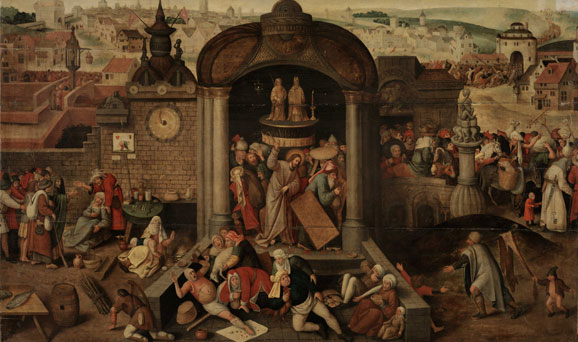
Christ Driving the Money-Lenders From the Temple
Brueghel Auction Update – Fall 2011

There was big news in the Bruegel-verse, with the fall 2011 auction season generating a new record for a price paid for a Brueghel the Younger painting. Brueghel expert Klaus Ertz called the version of “The Battle Between Carnival and Lent” which was sold “of masterly quality”, which certainly helped the work achieve a the record price of £6,873,250.
Of this sale, the New York Times’ Souren Melikian said:
“In the days of abundance, Pieter Brueghel the Younger’s vast allegory “The Battle Between Carnival and Lent” would not have aroused wild enthusiasm. No fewer than five versions of the subject have been recorded, of which three are from the painter’s own hand. These are not even original but are interpretations of Pieter Brueghel the Elder’s composition. On Dec. 7, 2006, “The Battle Between Carnival and Lent” cost £3.26 million at Christie’s. On Tuesday it rose to £6.87 million. The easy, large Brueghelian image appeals to a new generation of bidders loath to spend much time parsing the subtleties of great masters, whether in compositional inventiveness or the brilliance of brushwork.”
(NYT, 12/9/2011)
“The Mill and the Cross”
What we believe to be the first movie using Bruegel as a main character is now playing across North America. “The Mill and the Cross,” written by Lech Majewki and Michael Francis Gibson, and based on Gibson’s book, has Bruegel’s painting 1564 painting “Way to Calvary” come to life.
The movie has received mostly positive reviews, and currently has a 7.3/10 rating on IMDB.com
We look forward to providing a full review once we have had a chance to view the film.
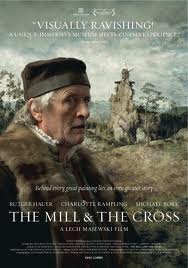
"The Mill and The Cross"
Welcome To BruegelNow
Welcome to Bruegel Now, the website that celebrates everything Bruegel / Brueghel related.
Although born nearly 500 years ago, Pieter Bruegel and his sons’ impact continue to be felt today. From museum exhibits to new monographs reprinting their painting to ever-increasing prices paid for their work at auction, the Bruegel / Brueghel phenomenon continues unabated. The Bruegel / Brueghel family members continue to be in the news, with the “discovery” of a Bruegel painting in Prado within the last year making the front pages of newspapers around the globe.
The purpose of this website is to provide one-stop access to all things happening “Now” in the Bruegel / Brueghel word. Movies, books, auctions and exhibitions are just some of the items that will be covered. Some of these items are academic in nature, while others firmly reside in pop culture. Regardless, both have a place in Bruegel Now.
You likely will notice that we have more material about the Pieters Bruegel / Brueghel than Jan Brueghel or the other Brueghels. This is because the Pieters interest us much more than Jan. In him time, Jan was much more popular than Peter. Jan Brueghel was a friend of Rubens and his art sold for much more than the works of Pieter the Younger. Now, hundreds of years later, the “inferior” Pieter the Younger paintings command multiples of what Jan sells for – sibling rivalry at the highest level!
This website is also a place to hear from you. We want to learn your thoughts on all things Bruegel / Brueghel, so don’t be shy about posting a comment to any of the stories that you see.
Welcome to Bruegel Now!
 BruegelNow